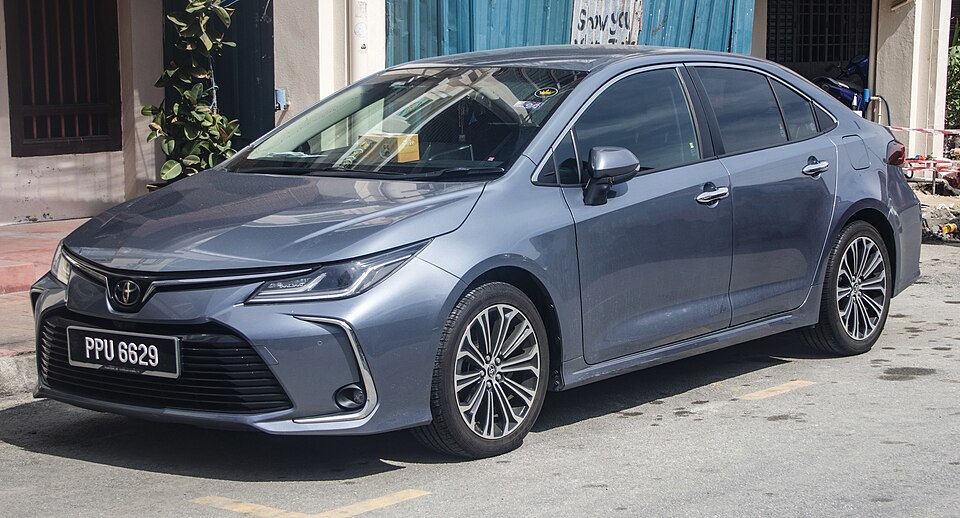
2020 Toyota Corolla

Complaints by component
A complaint can name multiple components.
Complaints by vehicle age
Years between the model year and the reported incident.
View as table
| 0 | 51 |
| 1 | 19 |
| 2 | 27 |
| 3 | 30 |
| 4 | 108 |
| 5 | 55 |
| 6 | 16 |
Complaints by odometer reading
Mileage at failure, where the complainant reported it. When this curve rises early, problems show up while the vehicle is still young.
View as table
| 0k | 32 |
| 10k | 12 |
| 20k | 2 |
| 30k | 7 |
| 40k | 1 |
| 50k | 2 |
| 60k | 2 |
| 70k | 1 |
| 80k | 2 |
| 90k | 2 |
| 100k | 0 |
| 110k | 2 |
| 120k | 0 |
| 130k | 3 |
Recalls (3)
air bags · 2023-12-20 · 23V865000
Toyota Motor Engineering & Manufacturing (Toyota) is recalling certain 2020-2021 Avalon, Avalon Hybrid, Corolla, Highlander, Highlander Hybrid, RAV4, RAV4 Hybrid, Lexus ES350, Lexus RX350, Lexus RX450H, 2021 Sienna Hybrid, Lexus ES250, 2020-2022 Camry, Camry Hybrid, and ES300H vehicles. A short circuit may develop in the Occupant Classification System (OCS) sensor, preventing the front passenger air bag from deploying.
Risk: An air bag that does not deploy during a crash increases the risk of injury.
Remedy: Dealers will inspect and replace the sensor as necessary, free of charge. Interim letters notifying owners of the safety risk were mailed in February 2024. Some final remedy owner letters were mailed October 31, 2024. Letters will continue to be mailed in phases through January 2026. Owners may contact Toyota customer service at 1-800-331-4331. Toyota's number for this recall is 23TB15/23TA15 Lexus 23LB03/23LA03.
fuel system, gasoline · 2020-04-11 · 20V682000
Toyota Motor Engineering & Manufacturing (Toyota) is recalling certain 2018-2019 4Runner, 2019-2020 Avalon, 2019 Corolla Hatchback, 2017-2019 Highlander, 2018-2020 Camry, 2020 Corolla, 2018-2019 Land Cruiser, 2017-2020 Tacoma, 2019-2020 RAV4, 2019-2020 Sequoia, 2017-2020 Sienna, 2019-2020 Tundra, 2018-2020 Lexus ES350, 2017 Lexus GS200t, 2017-2019 Lexus GS350, 2019 Lexus GS300, 2018-2020 Lexus LC500h, 2019-2020 Lexus LS500, 2018-2019 Lexus GX460, 2017 Lexus IS200t, 2019 Lexus IS300, 2019 Lexus IS350, 2018-2020 Lexus LC500, 2018 Lexus LS500, 2019 Lexus LS500h, 2018-2019 Lexus LX570, 2017 Lexus RC200t, 2019 Lexus RC300, RC350, 2017 and 2019-2020 Lexus RX350, 2018-2020 RX350L, 2019 Lexus UX200, 2018-2019 Lexus NX300 vehicles. The low-pressure fuel pump inside the fuel tank may fail.
Risk: If the fuel pump fails, the engine can stall while driving, increasing the risk of a crash.
Remedy: Toyota will notify owners, and dealers will replace the fuel pump assembly with an improved one, free of charge. Owners of specific models were notified that remedy parts were available starting January 21, 2021. Owners of other models will be notified as remedy parts become available. Remedy parts should be available for all affected vehicles by late March 2021. Owners may contact Toyota customer service at 1-888-270-9371 or Lexus customer service at 1-800-255-3987. Note: This recall is an expansion of recall 20V-012. Toyota's number for this recall is 20TA02. Lexus' number for this recall is 20LA01.
seat belts · 2019-11-12 · 19V877000
Toyota Motor Engineering & Manufacturing (Toyota) is recalling certain 2019-2020 C-HR and 2020 Corolla and Corolla Hybrid vehicles equipped with rear seat belt assemblies with a dual-mode locking mechanism. The seat belt webbing sensor locking mechanism may not lock as intended.
Risk: In the event of a crash involving multiple impacts, the seat belt may not properly restrain the occupant, increasing the risk of injury.
Remedy: Toyota will notify owners, and dealers will inspect the rear seat belt assembly production dates, and replace the assemblies, as necessary, free of charge. The recall began February 7, 2020. Owners may contact Toyota customer service at 1-888-270-9371. Toyota's numbers for this recall are 19TB22 and 19TA22.
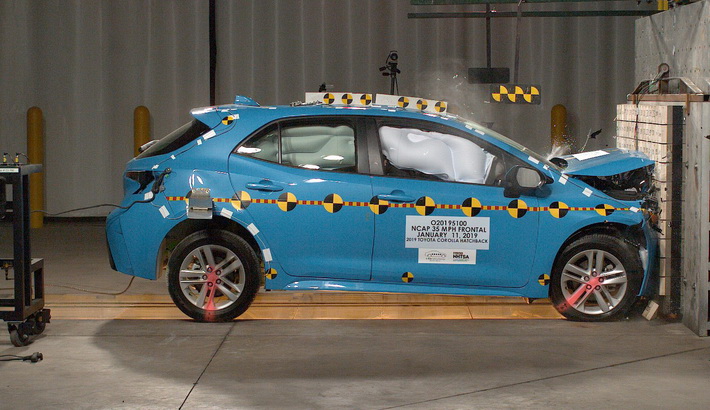
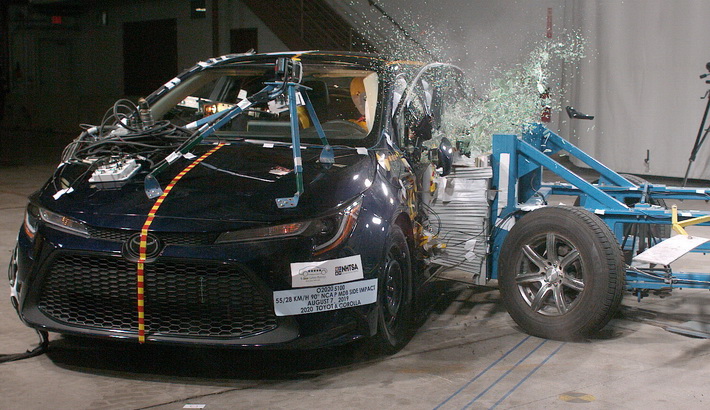
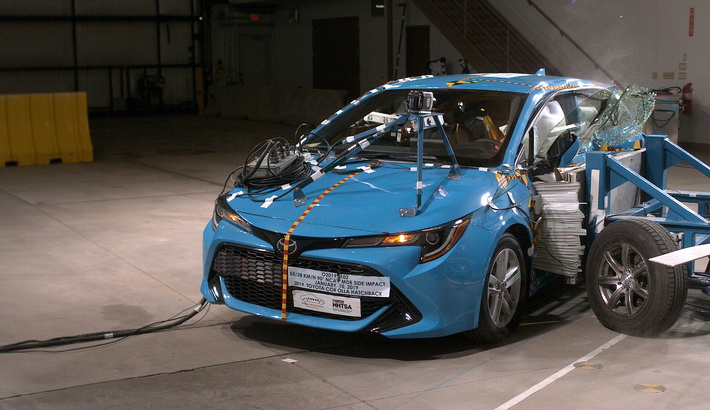
Crash-test ratings (NHTSA NCAP)
Recent complaints
DESIGN FLAW & SAFETY RISK: Toyota critically mismatched the standard battery to the vehicle's electrical charging profile; an AGM battery should be specified from the factory. Engine programming drops alternator voltage during cruising, deeply discharging the battery, and forces high-voltage surges (15V+) into it during deceleration. Because standard batteries cannot handle these rapid recharge loads during deceleration, the internal thermal load routinely overheats and boils the liquid electrolyte, even when brand new. This continuous boiling vents volatile hydrogen gas and discharges corrosive battery acid inside the engine bay. This structural flaw culminated in an immediate safety hazard when the battery physically exploded under the hood, creating a severe risk of engine compartment fire, chemical acid burns, and complete vehicle electrical blackout in active traffic. COLLATERAL DAMAGE & HISTORY: The chronic discharge and boiling of highly corrosive battery electrolyte severely damaged and corroded surrounding critical vehicle components. The acid completely corroded the transmission mount, the metal battery holder restraint, and the body paint. Furthermore, the corrosive boil-over burned off and destroyed several electrical connectors, plastic shrouds, plumbing hoses, and sections of the primary engine wiring cable harness. Since owning this 2020 Toyota Corolla, the vehicle has suffered systematic electrical degradation, requiring a full battery replacement at least once every single year. The exploded battery could not be safely retained due to its hazardous, ruptured state. WARNINGS & INSPECTIONS: No dashboard warning lamps, battery alerts, or diagnostic codes were triggered on the display prior to the physical battery failure. The rupture and electrical blackout occurred instantaneously. The vehicle has not been inspected by police or insurance representatives as no crash resulted directly from the blast.
FAILED COMPONENT & AVAILABILITY: The manual transmission Concentric Slave Cylinder (CSC) failed internally. Due to caustic hydraulic fluid contamination and severe system pressure loss, I had to replace the internal CSC unit, the clutch disc, the pressure plate, the flywheel, the master clutch cylinder, and the hydraulic clutch lines. The failed components have been retained and are available for inspection upon request. SAFETY RISK: The plastic housing of the OEM slave cylinder cracked internally, spraying caustic hydraulic brake fluid inside the transmission bell housing and completely coating the flywheel, pressure plate, and clutch friction disc. This caused an immediate, sudden loss of hydraulic pressure, forcing the clutch pedal to drop and stick flat to the floorboard. This put my safety and the safety of others at extreme risk, as it suddenly prevented me from disengaging the clutch, shifting gears, or safely dropping the vehicle into neutral while driving in active traffic.CONFIRMATION & REPAIR: A certified Toyota dealership diagnosed the issue and issued an unaffordable repair estimate of $4,800 to fix this recurring manufacturer defect. Because of this extreme cost, I was forced to drop the transmission and perform the entire rebuild myself. The total out-of-pocket cost just for replacement parts was $3,200. The vehicle has not been inspected by police or insurance representatives as no crash resulted. WARNINGS & MILEAGE SYMPTOMS: There were no prior dashboard warning lamps, error messages, or clear physical indicators before either failure occurred. The loss of clutch pedal pressure happened instantaneously. This vehicle has suffered this catastrophic internal failure twice: the original factory-installed unit (part number 31400-19025) failed prematurely at 59,000 miles. The updated replacement part (superseded part number 31400-19027), which suffers from the exact same defective plastic composition, failed again just 40,000 miles later.
Part is the coolant bypass valve. Toyota has been taken to court but dealership claims now that I’m over 100k miles I can’t do it. There was also a second part about 10 years but I wasn’t clear on the details of the outcome. Toyota has acknowledged this issue in court but failed to do so at the customer level in my case. engine light came on at 97k and now I’m at 104k which is over that 100k mark. Issue is I’ve only take my car to Toyota for repairs. They have known about this but failed to repair or notify me of it. I would have immediately brought my car in at 97k if. I had known. This puts not only me but my 3 kids and entire family at risk every time i drive. This is known to the dealership and they been taken to court for failures to notify customers of this known defect. It’s been inspected by Toyota the last time I took it in about a week ago at 104k miles.
Design issue: The 12th-generation (E210) Corolla manual transmission utilizes a CSC unit containing plastic/ABS components that owners and forum communities frequently cite as a weak point prone to premature leakage and mechanical failure. This occured to my corolla on a roadway and presented a severe safety hazard.
The contact owns a 2020 Toyota Corolla. The contact stated that while driving at an undisclosed speed, the clutch failed to operate as intended. The contact stated that the clutch seized, and the RPM increased. No warning lights were illuminated. The vehicle was taken to the dealer; however, the failure was not duplicated. The contact stated that the failure reoccurred. The vehicle was not diagnosed or repaired by an independent mechanic or dealer. The manufacturer was not made aware of the failure. The failure mileage was approximately 90,330.