2015 Toyota Camry

Complaints by component
A complaint can name multiple components.
Complaints by vehicle age
Years between the model year and the reported incident.
View as table
| 0 | 25 |
| 1 | 30 |
| 2 | 26 |
| 3 | 51 |
| 4 | 49 |
| 5 | 37 |
| 6 | 14 |
| 7 | 11 |
| 8 | 8 |
| 9 | 8 |
| 10 | 8 |
| 11 | 2 |
Complaints by odometer reading
Mileage at failure, where the complainant reported it. When this curve rises early, problems show up while the vehicle is still young.
View as table
| 0k | 43 |
| 10k | 20 |
| 20k | 24 |
| 30k | 19 |
| 40k | 25 |
| 50k | 8 |
| 60k | 19 |
| 70k | 10 |
| 80k | 17 |
| 90k | 7 |
| 100k | 5 |
| 110k | 4 |
| 120k | 3 |
| 130k | 2 |
| 140k | 1 |
| 150k+ | 3 |
Recalls (1)
steering · 2015-03-13 · 15V144000
Toyota Motor Engineering & Manufacturing (Toyota) is recalling certain model year 2015 Camry, Camry Hybrid, Highlander, and Highlander Hybrid, and 2014-2015 Rav4 vehicles. A component of the electric power steering (EPS) electronic control unit (ECU) may have been damaged during the manufacturing process. Over time, this damage may result in failure of the electric power steering system.
Risk: An unexpected loss of power steering increases the risk of a crash.
Remedy: Toyota will notify owners, and dealers will inspect the serial number of the EPS ECU or steering column assembly. If the number is within the affected range, the EPS ECU will be replaced, free of charge. The recall began on May 7, 2015. Owners may contact Toyota customer service at 1-800-331-4331.
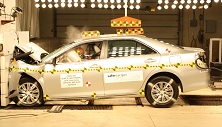
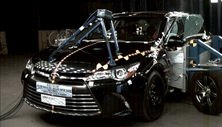
Crash-test ratings (NHTSA NCAP)
Recent complaints
The contact owns a 2015 Toyota Camry. The contact stated that the infotainment system had become inoperable. The vehicle was not diagnosed or repaired by an independent mechanic or dealer. The manufacturer was notified of the failure and referred the contact to the dealer. The failure mileage was unknown.
The vehicle's braking system intermittently self-activates, engaging the brakes with no obstruction, pedestrian, or object present in the vehicle's path and no driver input. This creates an unpredictable, unprovoked braking event while driving, which is a direct safety hazard to the driver and to other vehicles on the road that may not anticipate sudden deceleration. A distinct pattern has been observed: after the brake pedal is touched, the vehicle behaves as though it believes it is on an incline, repeatedly reapplying the brakes on its own in a pulsing or repeated manner, even on flat, level ground with no incline present. This repeated self-application occurs without further driver input. The dealership has attempted repairs on multiple occasions. On the first visit, the brake booster was replaced. This did not resolve the issue, and additionally caused the brake lights to remain illuminated overnight, draining the vehicle battery. On a second visit, a brake bracket was replaced; the self-braking defect recurred within minutes of leaving the dealership. On a third visit, the vehicle was retained by the dealership for approximately three weeks, during which a brake switch was replaced; the defect recurred after approximately one day of normal driving. The problem has been reproduced and acknowledged by the dealership's service department on multiple occasions, as evidenced by the repeated repair attempts targeting the braking system (brake booster, brake bracket, brake switch). Despite three separate repair attempts across different brake-related components, the dealership has been unable to identify or correct the root cause. Dealership service management stated they can only make repair recommendations and cannot guarantee that any given repair will resolve the issue, and that their process involves replacing parts until the defect happens to stop occurring. The dashboard brake warning light is on, and an ABS warning light also illuminates intermittently.
On Friday, December 5, 2025, I was coming out of the driveway at the Jack In The Box on the corner of El Camino & Nobili Avenue in Santa Clara. My foot was on the break as I was going to stop at the end of the driveway to check to see if there was any traffic coming down Nobili before I exited the Jack In The Box driveway. All of a sudden before I even hit the end of the driveway while I had my foot on the brake, the car started to speed up (unintentional acceleration)and I continued to press my foot down harder on the brake, but nothing could stop it. A lot of black smoke came up out of the steering wheel area where it attached to the dashboard & all of the air bags around the car deployed. Then my car completely turned itself around and the front of my car was now facing the driveway that I had just come out of. This torque of acceleration and braking is why my car spun around 180 degrees. The vehicle had sustained damage to the front end, the hood, front bumper cover, right front head lamp was cracked, and the Toyota emblem was missing. (See attached photos taken at the time of the accident) Since all of the air bags in the whole car had completely deployed, I found that the only way I could get out of the car was to slide myself under the air bag that surrounded the driver side door. As I got out of the car, the rib that is directly under my right breast began to hurt very badly and it was hard for me to take a breath with the pain from that rib. I also had a bad headache, too. Plus, the top of my left hand was all red and felt like something had scratched the whole back of my hand. It hurt to touch it. I was also light-headed.The car, I was told, looked like I had hit a wall. The whole left front side of the car was severely mangled - the hood, the fender, and the tire was flat. The shocking thing was that I had not had an encounter with any car, nor had they hit me, to account for this damage.The Police & Fire Dept.& EMT's were called.
My white paint has started chipping in big chucks all over the car on every panel
Factory paint is delaminating and peeling in large sheets without collision damage. This appears consistent with known Toyota paint defects affecting similar vehicles.