2020 Honda CR-V

Complaints by component
A complaint can name multiple components.
Complaints by vehicle age
Years between the model year and the reported incident.
View as table
| 0 | 33 |
| 1 | 33 |
| 2 | 45 |
| 3 | 57 |
| 4 | 68 |
| 5 | 58 |
| 6 | 66 |
Complaints by odometer reading
Mileage at failure, where the complainant reported it. When this curve rises early, problems show up while the vehicle is still young.
View as table
| 0k | 37 |
| 10k | 9 |
| 20k | 7 |
| 30k | 6 |
| 40k | 6 |
| 50k | 7 |
| 60k | 2 |
| 70k | 3 |
| 80k | 1 |
| 90k | 0 |
| 100k | 1 |
| 110k | 1 |
| 120k | 1 |
| 130k | 0 |
| 140k | 0 |
| 150k+ | 2 |
Recalls (7)
air bags · 2026-05-21 · 26V332000
Honda (American Honda Motor Co.) is recalling certain 2018-2021, 2023 Acura TLX, 2019-2024 RDX, 2017-2020, 2022-2026 MDX, 2017-2021, 2023, 2025 Honda Ridgeline, 2017-2022 Pilot, 2019-2021 Passport, 2018-2026 Odyssey, 2019-2022 Insight, 2019-2021 HR-V, 2018-2020 Fit, 2020-2022 CR-V Hybrid, 2017-2022 CR-V, 2017-2018, 2021 Civic Type R, 2017-2021 Civic hatchback, 2016-2020 Civic coupe, 2016-2022 Civic, 2017-2022 Accord Hybrid, and 2016-2022 Accord vehicles. The front passenger seat weight sensor may crack and short circuit, which can cause the air bags to deploy unintentionally during a crash.
Risk: Air bags that deploy unintentionally during a crash increase the risk of injury.
Remedy: Dealers will replace the seat weight sensors, free of charge. Owner notification letters were mailed July 7, 2026. Owners may contact Honda's customer service at 1-888-234-2138. Honda's numbers for this recall are BOL, WO9, OOA, WOM, XOH, NOC, POD, BOE, UOF, POB, EOG, AOI, QO8, TOJ, DO7, and SOK. This recall expands previous NHTSA recall number 24V064. Vehicle Identification Numbers (VINs) involved in this recall will be searchable on NHTSA.gov beginning May 29, 2026.
air bags · 2024-01-02 · 24V064000
Honda (American Honda Motor Co.) is recalling certain 2020-2022 Pilot, Accord, Civic sedan, HR-V, Odyssey, 2020 Civic coupe, Fit, 2021-2022 Civic hatchback, 2021 Civic Type R, Insight, 2020-2021 CR-V, CR-V Hybrid, Passport, Ridgeline, Accord Hybrid, 2020 Acura MDX, 2022 Acura MDX, 2020-2022 Acura RDX, and 2020-2021 Acura TLX vehicles. The front passenger seat weight sensor may crack and short circuit, failing to suppress the air bag as intended.
Risk: An air bag that deploys unintentionally during a crash can increase the risk of injury.
Remedy: Dealers will replace the seat weight sensors, free of charge. Owner notification letters were mailed March 28, 2024. This is a phased recall. Owners may contact Honda customer service at 1-888-234-2138. Honda's numbers for these recalls are XHP and VHQ.
fuel system, gasoline · 2023-12-18 · 23V858000
Honda (American Honda Motor Co.) is recalling certain 2013-2023 Honda Accord, Civic Coupe, Civic Sedan, Civic Hatchback, Civic Type R, CR-V, HR-V, Ridgeline, Odyssey, Acura ILX, MDX, MDX Hybrid, RDX, RLX, TLX, 2019-2022 Honda Insight, Passport, 2020 Honda CR-V Hybrid, 2018-2019 Honda Clarity PHEV, Fit, and 2015-2020 Honda Accord Hybrid, Pilot, Acura NSX vehicles. The fuel pump inside the fuel tank may fail.
Risk: Fuel pump failure can cause an engine stall while driving, increasing the risk of a crash.
Remedy: Dealers will replace the fuel pump module, free of charge. Owner letters were mailed September 6, 2024. Owners may contact Honda customer service at 1-888-234-2138. Honda's numbers for this recall are KGC and KGD. This recall is an expansion of NHTSA recall numbers 21V-215 and 20V-314.
seat belts · 2023-09-03 · 23V158000
Honda (American Honda Motor Co.) is recalling certain 2017-2020 CR-V, 2018-2019 Accord and Accord Hybrid, 2018-2020 Odyssey, 2019 Insight, and 2019-2020 Acura RDX vehicles. A manufacturing issue with the front seat belts may cause the seat belt buckle channel to interfere with the release button, preventing the seat belt buckle from latching.
Risk: An unlatched seat belt cannot properly restrain the seat occupant during a crash, increasing their risk of injury.
Remedy: Dealers will replace the driver and front passenger seat belt buckle release buttons or the buckle assemblies as necessary, free of charge. Owner notification letters were mailed April 18, 2023. Owners may contact Honda customer service at 1-888-234-2138. Honda's numbers for this recall are NDA, QDB, BDC, MDD, LD9. TDF, FDG, ODH, YDI, ZDE.
equipment · 2023-07-27 · 23V524000
Honda (American Honda Motor Co.) is recalling certain 2017, 2020, and 2022 CR-V vehicles. The certification label on the driver's side door states incorrect Gross Vehicle Weight Rating (GVWR), Gross Axle Weight Rating (GAWR), and tire size information. As such, these vehicles fail to comply with the requirements of Federal Motor Vehicle Safety Standard number 110, "Tire Selection and Rims."
Risk: An incorrectly sized tire may cause premature tread wear, or a tire blow out, increasing the risk of a crash.
Remedy: Dealers will install a new corrected label, free of charge. Owner notification letters were mailed September 18, 2023. Owners may contact Honda customer service at 1-888-234-2138. Honda's number for this recall is CF7.
fuel system, gasoline · 2022-05-26 · 22V380000
Honda (American Honda Motor Co.) is recalling certain 2020 CR-V vehicles. The clip for the absorber inside the fuel tank was not secured properly and may detach, which can cause an inaccurate fuel gauge reading.
Risk: An inaccurate fuel gauge may result in the vehicle unexpectedly running out of fuel and stalling, increasing the risk of a crash.
Remedy: Dealers will replace the fuel tank, free of charge. Owner notification letters were mailed July 5, 2022. Owners may contact Honda customer service at 1-888-234-2138. Honda's number for this recall is RCB.
structure · 2019-05-12 · 19V865000
Honda (American Honda Motor Co.) is recalling certain 2019-2020 CR-V vehicles. The rear subframe bolts were improperly manufactured and may loosen, allowing the rear subframe to separate.
Risk: A separated rear subframe reduces vehicle handling and can suddenly disable the vehicle, increasing the risk of a crash.
Remedy: Honda will notify owners, and dealers will inspect the rear subframe bolts and retorque them or replace them, as necessary, free of charge. The recall began January 27, 2020. Owners may contact Honda customer service at 1-888-234-2138. Honda's number for this recall is R6M.
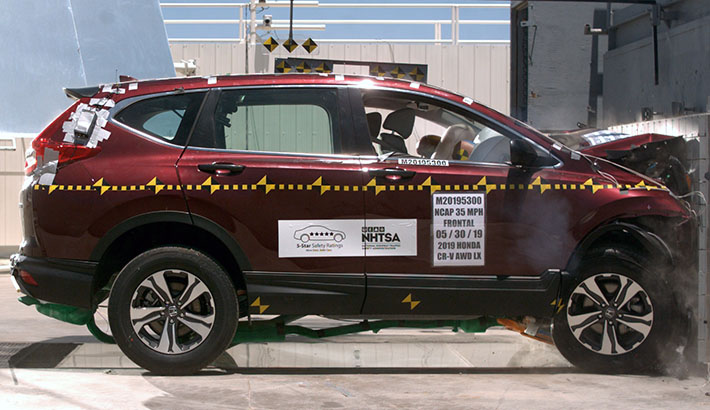
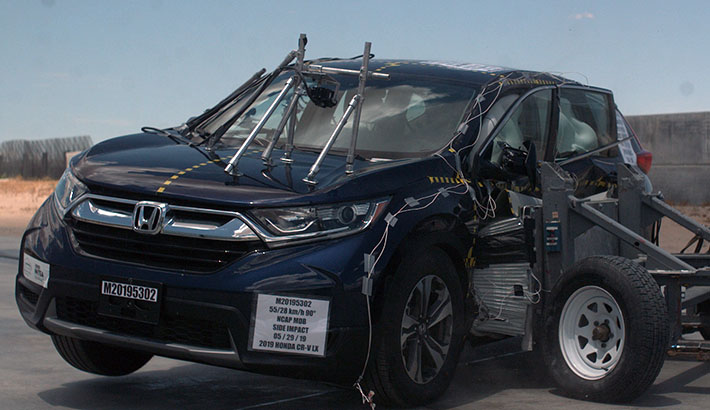
Crash-test ratings (NHTSA NCAP)
Recent complaints
At under 36,000 miles, the vehicle experienced a sudden and total failure of the factory electronic brake booster assembly. The vehicle's dashboard illuminated multiple critical braking system warning lights. The vehicle was taken directly to an authorized Honda dealership for diagnostic testing. The dealership pulled Diagnostic Trouble Code DTC C1250-98 (ECU Internal Malfunction - Over Temperature), confirming a hard internal electronic processor failure within the brake booster unit itself. The dealership had to completely remove and replace the faulty electronic brake booster assembly, costing $3,206.00 out of pocket for parts and labor. An internal computer processor overheating on a critical, non-maintenance braking component at this incredibly low mileage represents a severe safety hazard and indicates a manufacturing or supplier defect. Honda has previously issued safety recalls for integrated electronic brake booster faults on other models from this production window (such as NHTSA Campaign 23V431000), but has not yet extended coverage to the 2020 CR-V. I am filing this report to document the premature component failure and urge an expansion of the safety recall to encompass this model year.
In XXX I began experiencing a sticking/notching sensation in the steering wheel. Because this involves the steering system and therefore raises an obvious safety concern, we contacted Honda Customer Service and opened Case #XXX. Honda Customer Service instructed us to take the vehicle to an authorized Honda dealer for evaluation. We took the vehicle to Fred Anderson Honda in Greenville, South Carolina where the steering problem was inspected, verified and documented. They determined it was a sticking gear box. During our research, we became aware of NHTSA Safety Recall 24V-744, which involves a steering gearbox problem on certain Honda and Acura vehicles, including certain 2023–2025 CR-V and CR-V Hybrid vehicles. Additionally, there are reported cases with other 2020 Honda CR-V along with previous years. The sticking/notching has gotten worse since being noticed. Which has caused oversteering that could resulting in an accident. Honda wants to charge $5,817 to install a new steering rack. We requested a Full Goodwill Assistance to fix the issues. They offered to pay $1,620 of the amount leaving us with the balance. We believe the problem is a manufacturing defect and should be recalled. There were no warning lights or messages. Only symptom was the sticking/notching sensation. Your help on this would be greatly appreciated. Thank you.
At 29,100 miles on the odometer I started noticing a little difference in the steering, especially at low speeds. There were no dashboard warning messages. I took it to a local Honda Service Center (Vatland Honda) and they diagnosed the problem as "Electric steering rack internal failure" and an estimated repair cost approaching 6,000 after taxes and fees. They said there's no way to predict if or when the power steering would completely fail, but it could be a sudden event. I left with the impression that even total steering failure was a possibility. Because of the high cost estimate, I took it to a second Service Center (Coggin Honda) for an estimate. They checked the car and came to the same conclusion as the first Service Center. However, their cost of repair was lower (5,375 including tax), and I had them repair the car yesterday (9/17/26). I had also contacted Honda America and asked if they would agree to cover this repair under warranty even though I'm beyond the warranty time period. I felt there must have been a manufacturing defect to have a failure of this type at such low mileage. They reviewed my request and agreed to pay 80% of the repair cost. I'm grateful that Honda America has covered most of the cost, but I'm filing this report because I've read on some online forums that other 2020 Honda CRV owners have had a similar problem. If this is more than just an isolated event, I feel a recall may be warranted for this car part.
No warning lamps. Steering is "sticky". Driving at higher speeds such as on the interstate. Steering to the left then when straightening the steering wheel, it is sticky. Dangerous especially at higher speeds. May cause the driver to over correct steering. Putting them and others around them in danger of colliding. Other Honda Crv models have recalls for this issue. My vehicle is no safer with the issue and deserves to be addressed as well.
Honda Dealership (Grainger Honda in [XXX]) replaced a steering neck on my 2020 Honda CRV at approximately 87,000 miles in XXX The vehicle was brought into the dealership in XXX with symptoms of loose steering, creaks/groans during turns/curves and the steering wheel was catching during turns/corners. The recommendation by Honda was to replace the struts, which was completed at another location. The symptoms became evident again in the summer of 2026 and in XXX was advised by Honda to replace the steering neck. The dealership had to order the part and advised that this was a safety issue, and the car should not be driven until repair completed. The replacement of the steering neck resolved the steering issues with the vehicle. . My family had been driving an unsafe vehicle since 2025? No warnings from vehicle system. The 2020 Honda CRV was not part of a recall; however 2023-2025 Honda CRVs had a recall for the same issue with steering neck and symptoms aligned with symptoms experienced with a 2020 model. I have filed a complaint with American Honda as the repairs cost over 5,000 and failure of this critical component is outside expectations for a vehicle of this age and mileage. INFORMATION REDACTED PURSUANT TO THE FREEDOM OF INFORMATION ACT (FOIA), 5 U.S.C. 552(B)(6)