2019 Honda CR-V

Complaints by component
A complaint can name multiple components.
Complaints by vehicle age
Years between the model year and the reported incident.
View as table
| 0 | 182 |
| 1 | 102 |
| 2 | 76 |
| 3 | 152 |
| 4 | 159 |
| 5 | 197 |
| 6 | 135 |
| 7 | 103 |
Complaints by odometer reading
Mileage at failure, where the complainant reported it. When this curve rises early, problems show up while the vehicle is still young.
View as table
| 0k | 143 |
| 10k | 43 |
| 20k | 29 |
| 30k | 26 |
| 40k | 18 |
| 50k | 14 |
| 60k | 7 |
| 70k | 9 |
| 80k | 4 |
| 90k | 3 |
| 100k | 3 |
| 110k | 0 |
| 120k | 2 |
| 130k | 0 |
| 140k | 2 |
| 150k+ | 5 |
Recalls (8)
air bags · 2026-05-21 · 26V332000
Honda (American Honda Motor Co.) is recalling certain 2018-2021, 2023 Acura TLX, 2019-2024 RDX, 2017-2020, 2022-2026 MDX, 2017-2021, 2023, 2025 Honda Ridgeline, 2017-2022 Pilot, 2019-2021 Passport, 2018-2026 Odyssey, 2019-2022 Insight, 2019-2021 HR-V, 2018-2020 Fit, 2020-2022 CR-V Hybrid, 2017-2022 CR-V, 2017-2018, 2021 Civic Type R, 2017-2021 Civic hatchback, 2016-2020 Civic coupe, 2016-2022 Civic, 2017-2022 Accord Hybrid, and 2016-2022 Accord vehicles. The front passenger seat weight sensor may crack and short circuit, which can cause the air bags to deploy unintentionally during a crash.
Risk: Air bags that deploy unintentionally during a crash increase the risk of injury.
Remedy: Dealers will replace the seat weight sensors, free of charge. Owner notification letters were mailed July 7, 2026. Owners may contact Honda's customer service at 1-888-234-2138. Honda's numbers for this recall are BOL, WO9, OOA, WOM, XOH, NOC, POD, BOE, UOF, POB, EOG, AOI, QO8, TOJ, DO7, and SOK. This recall expands previous NHTSA recall number 24V064. Vehicle Identification Numbers (VINs) involved in this recall will be searchable on NHTSA.gov beginning May 29, 2026.
fuel system, gasoline · 2023-12-18 · 23V858000
Honda (American Honda Motor Co.) is recalling certain 2013-2023 Honda Accord, Civic Coupe, Civic Sedan, Civic Hatchback, Civic Type R, CR-V, HR-V, Ridgeline, Odyssey, Acura ILX, MDX, MDX Hybrid, RDX, RLX, TLX, 2019-2022 Honda Insight, Passport, 2020 Honda CR-V Hybrid, 2018-2019 Honda Clarity PHEV, Fit, and 2015-2020 Honda Accord Hybrid, Pilot, Acura NSX vehicles. The fuel pump inside the fuel tank may fail.
Risk: Fuel pump failure can cause an engine stall while driving, increasing the risk of a crash.
Remedy: Dealers will replace the fuel pump module, free of charge. Owner letters were mailed September 6, 2024. Owners may contact Honda customer service at 1-888-234-2138. Honda's numbers for this recall are KGC and KGD. This recall is an expansion of NHTSA recall numbers 21V-215 and 20V-314.
seat belts · 2023-09-03 · 23V158000
Honda (American Honda Motor Co.) is recalling certain 2017-2020 CR-V, 2018-2019 Accord and Accord Hybrid, 2018-2020 Odyssey, 2019 Insight, and 2019-2020 Acura RDX vehicles. A manufacturing issue with the front seat belts may cause the seat belt buckle channel to interfere with the release button, preventing the seat belt buckle from latching.
Risk: An unlatched seat belt cannot properly restrain the seat occupant during a crash, increasing their risk of injury.
Remedy: Dealers will replace the driver and front passenger seat belt buckle release buttons or the buckle assemblies as necessary, free of charge. Owner notification letters were mailed April 18, 2023. Owners may contact Honda customer service at 1-888-234-2138. Honda's numbers for this recall are NDA, QDB, BDC, MDD, LD9. TDF, FDG, ODH, YDI, ZDE.
fuel system, gasoline · 2021-03-25 · 21V215000
Honda (American Honda Motor Co.) is recalling certain 2019-2020 Acura MDX, MDX Sport Hybrid, RDX, TLX, Honda Accord, Civic Hatchback, Insight, 2019 Acura ILX, Honda Accord Hybrid, Civic Coupe, Civic Coupe Si, Civic Sedan, Civic Sedan Si, Civic Type R, Fit, HR-V, Odyssey, Passport, Pilot and Ridgeline, and 2018-2019 CR-V vehicles. The low-pressure fuel pump inside the fuel tank may fail.
Risk: Fuel pump failure can cause an engine stall while driving, increasing the risk of a crash.
Remedy: Honda will notify owners, and dealers will replace the fuel pump assembly, free of charge. Owner letters were mailed May 18, 2021. Owners may contact Honda customer service at 1-888-234-2138. Note: This recall is an expansion of recall 20V-314.
equipment · 2019-09-26 · 19V694000
Honda (American Honda Motor Co.) is recalling certain 2019 CR-V vehicles. The owner's guide incorrectly describes when the "Passenger Airbag Off" indicator should illuminate. As such, these vehicles fail to comply with the requirements of Federal Motor Vehicle Safety Standard (FMVSS) number 208, "Occupant Crash Protection."
Risk: If the front passenger does not correctly understand how the airbag functions, they may be at an increased risk of personal injury in the event of a crash.
Remedy: Honda will notify owners and provide a sticker with the correct information to be added to the owner's guide, free of charge. The recall began November 14, 2019. Owner's may contact Honda customer service at 1-888-234-2138. Honda's number for this recall is X6G.
air bags · 2019-05-21 · 19V383000
Honda (American Honda Motor Co.) is recalling certain 2019 CR-V vehicles. The metal core of the steering wheel may have burrs which can damage the harnesses routed within, potentially disabling the driver's air bag or causing it to deploy without warning.
Risk: In the event of a crash, a disabled air bag would increase the risk of injury. An uncommanded deployment of the driver's air bag also increases the risk of injury and a crash.
Remedy: Honda will notify owners, and dealers will install a protective cover on the steering wheel core and replace clockspring and the harnesses within, free of charge. The recall began July 8, 2019. Owners may contact Honda customer service at 1-888-234-2138. Honda's number for this recall is R4S.
structure · 2019-05-12 · 19V865000
Honda (American Honda Motor Co.) is recalling certain 2019-2020 CR-V vehicles. The rear subframe bolts were improperly manufactured and may loosen, allowing the rear subframe to separate.
Risk: A separated rear subframe reduces vehicle handling and can suddenly disable the vehicle, increasing the risk of a crash.
Remedy: Honda will notify owners, and dealers will inspect the rear subframe bolts and retorque them or replace them, as necessary, free of charge. The recall began January 27, 2020. Owners may contact Honda customer service at 1-888-234-2138. Honda's number for this recall is R6M.
fuel system, gasoline · 2019-01-08 · 19V569000
Honda (American Honda Motor Co.) is recalling certain 2019 CR-V vehicles. The joint weld between the fuel tank and the vapor return line may have been insufficiently welded, causing the weld to fail.
Risk: The failed weld may allow fuel to leak, increasing the risk of a fire in the presence of an ignition source.
Remedy: Honda will notify owners, and dealers will replace the fuel tank, free of charge. The recall began September 16, 2019. Owners may contact Honda customer service at 1-888-234-2138. Honda's number for this recall is A5I.
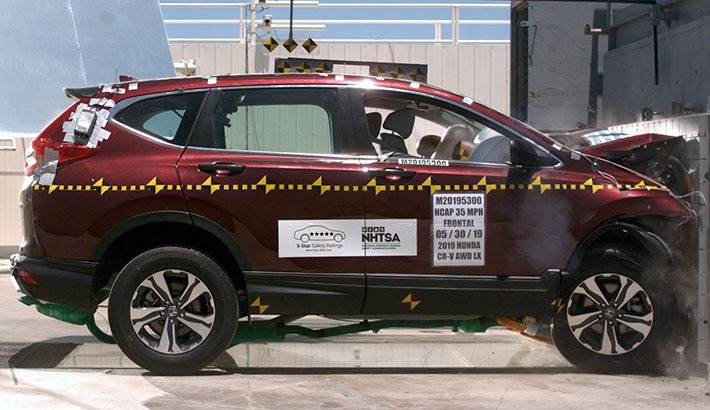
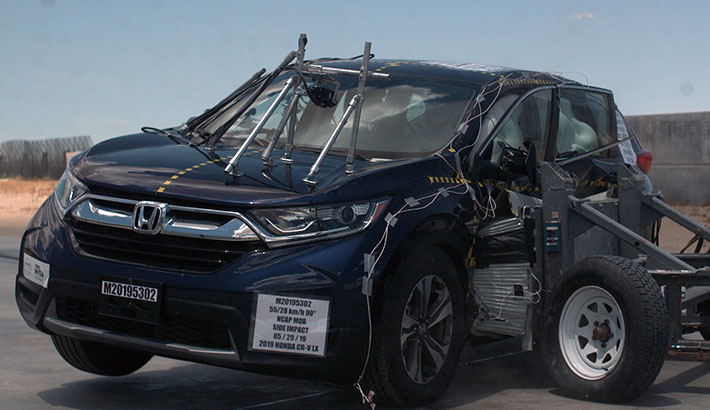
Crash-test ratings (NHTSA NCAP)
Recent complaints
Steering wheel is glitchy and sticky when changing lanes or turning. Feels stuck at times. Dangerous to operate. Suspect same issue in existing recalls for other years of Honda CR-V. The 2029 needs to be added to this safety recall (gearbox etc?). You have other reports in file from 2029 owners. It’s time to take this seriously and make official recall.
I was driving about 20-25 mph. There was absolutely nothing in front of me and my car came to a dead stop, the brake warning light came up on the screen and I hit my head off the steering wheel. Then the warning went away and I drove the last 2 minutes home.
The contact owns a 2019 Honda CR-V. The contact stated that while driving 70 MPH, the steering wheel became stuck while driving in a straight line. The contact associated the failure with NHTSA Campaign Number: 24V744000 (Steering); however, the VIN was not included in the recall. The dealer was contacted by phone. The failure mileage was approximately 25,000.
Inaccurate fuel tank readings
Since Oct1st night, my car smells of Gasoline inside and out side the car. It just started late evening. And takes time to start?