2016 Honda Civic

Complaints by component
A complaint can name multiple components.
Complaints by vehicle age
Years between the model year and the reported incident.
View as table
| 0 | 143 |
| 1 | 68 |
| 2 | 78 |
| 3 | 153 |
| 4 | 154 |
| 5 | 84 |
| 6 | 77 |
| 7 | 89 |
| 8 | 97 |
| 9 | 84 |
| 10 | 55 |
Complaints by odometer reading
Mileage at failure, where the complainant reported it. When this curve rises early, problems show up while the vehicle is still young.
View as table
| 0k | 135 |
| 10k | 48 |
| 20k | 58 |
| 30k | 68 |
| 40k | 64 |
| 50k | 43 |
| 60k | 29 |
| 70k | 13 |
| 80k | 11 |
| 90k | 8 |
| 100k | 5 |
| 110k | 1 |
| 120k | 0 |
| 130k | 0 |
| 140k | 2 |
| 150k+ | 6 |
Recalls (5)
air bags · 2026-05-21 · 26V332000
Honda (American Honda Motor Co.) is recalling certain 2018-2021, 2023 Acura TLX, 2019-2024 RDX, 2017-2020, 2022-2026 MDX, 2017-2021, 2023, 2025 Honda Ridgeline, 2017-2022 Pilot, 2019-2021 Passport, 2018-2026 Odyssey, 2019-2022 Insight, 2019-2021 HR-V, 2018-2020 Fit, 2020-2022 CR-V Hybrid, 2017-2022 CR-V, 2017-2018, 2021 Civic Type R, 2017-2021 Civic hatchback, 2016-2020 Civic coupe, 2016-2022 Civic, 2017-2022 Accord Hybrid, and 2016-2022 Accord vehicles. The front passenger seat weight sensor may crack and short circuit, which can cause the air bags to deploy unintentionally during a crash.
Risk: Air bags that deploy unintentionally during a crash increase the risk of injury.
Remedy: Dealers will replace the seat weight sensors, free of charge. Owner notification letters were mailed July 7, 2026. Owners may contact Honda's customer service at 1-888-234-2138. Honda's numbers for this recall are BOL, WO9, OOA, WOM, XOH, NOC, POD, BOE, UOF, POB, EOG, AOI, QO8, TOJ, DO7, and SOK. This recall expands previous NHTSA recall number 24V064. Vehicle Identification Numbers (VINs) involved in this recall will be searchable on NHTSA.gov beginning May 29, 2026.
fuel system, gasoline · 2023-12-18 · 23V858000
Honda (American Honda Motor Co.) is recalling certain 2013-2023 Honda Accord, Civic Coupe, Civic Sedan, Civic Hatchback, Civic Type R, CR-V, HR-V, Ridgeline, Odyssey, Acura ILX, MDX, MDX Hybrid, RDX, RLX, TLX, 2019-2022 Honda Insight, Passport, 2020 Honda CR-V Hybrid, 2018-2019 Honda Clarity PHEV, Fit, and 2015-2020 Honda Accord Hybrid, Pilot, Acura NSX vehicles. The fuel pump inside the fuel tank may fail.
Risk: Fuel pump failure can cause an engine stall while driving, increasing the risk of a crash.
Remedy: Dealers will replace the fuel pump module, free of charge. Owner letters were mailed September 6, 2024. Owners may contact Honda customer service at 1-888-234-2138. Honda's numbers for this recall are KGC and KGD. This recall is an expansion of NHTSA recall numbers 21V-215 and 20V-314.
parking brake · 2016-11-10 · 16V725000
Honda (American Honda Motor Co.) is recalling certain model year 2016 Honda Civic two door and four door 1.5L turbo and 2.0L vehicles. The electric parking brake (EPB) may not engage if it is applied immediately after turning the ignition off.
Risk: If the EPB is not applied, the vehicle may roll away, increasing the risk of a crash.
Remedy: Honda will notify owners, and dealers will update the vehicle's software to allow the EPB to engage immediately after the ignition is turned off, free of charge. The recall began on November 8, 2016. Owners may contact Honda customer service at 1-888-234-2138. Honda's number for this recall is KC6.
exterior lighting · 2016-11-07 · 16V526000
American Honda Motor Co. (Honda) is recalling certain model year 2016 Civic 2-Door vehicles manufactured February 23, 2016, through May 20, 2016. The affected vehicles may have a damaged LED side marker light circuit board inside the taillight assembly, making the marker light inoperable. As such, these vehicles fail to comply with the requirements of Federal Motor Vehicle Safety Standard (FMVSS) number 108, "Lamps, Reflective Devices, and Assoc. Equipment."
Risk: If a side marker light does not function, vehicle visibility can be decreased to other drivers, increasing the risk of a crash.
Remedy: Honda will notify owners, and dealers will inspect both the taillight assemblies, replacing them as necessary, free of charge. The recall began on August 31, 2016. Owners may contact Honda customer service at 1-888-234-2138. Honda's number for this recall is KB8.
engine and engine cooling · 2016-09-02 · 16V074000
Honda (American Honda Motor Co.) is recalling certain model year 2016 Civic vehicles manufactured September 22, 2015, to February 3, 2016 and equipped with 2.0L engines. The affected vehicles have engines with piston assemblies that may have been manufactured without a piston wrist pin circlip or with an incorrectly installed piston wrist pin circlip.
Risk: If a circlip is missing or incorrectly installed, the piston wrist pin may not be secure and may drift and damage the engine cylinder causing the engine to seize, and increasing the risk of a crash or a fire.
Remedy: Honda will notify owners, and dealers will inspect and replace the piston assemblies and damaged engine components, as necessary, free of charge. Parts are expected to be available in the Summer of 2016. Owners were mailed an interim notification beginning March 31, 2016, and will be mailed a second notice when parts are available. Owners may contact Honda customer service at 1-888-234-2138. Honda's number for this recall is JX9.
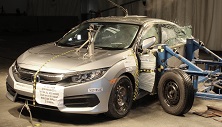
Crash-test ratings (NHTSA NCAP)
Recent complaints
Power steering rack needs replacement. No damage cause by myself. Later models of the same vehicle have recalls on the power steering rack. The steering wheel will “stick” when driving and i’ll have to use excessive force to turn the wheel even just slightly causing the vehicle to jerk around.
When driving at highway speeds/long distances, steering occasionally gets stiffer to the point where it will stick and require more force to free. This leads to overcorrections and constant adjustments for the duration of the drive, as well as difficulty staying in a lane. Issue can usually only be replicated when driving longer distances on the highway, especially when driving on a straight road.
When the Honda Civic has been driven long enough for the steering to get warm, at highway speeds, the steering wheel will stick in position instead of centering itself. Manual adjustment has to be done to straighten the car.
Mostly during warm weather and driving over 45MPH the steering gets sticky. When attempting to use a little pressure to make a slight correction to keep the care centered in the lane the steering "jumps" and over steers requiring to re-correct to stay centered in the lane. I'm having to keep correcting the steering which causes me difficulty and concerned about the safety especially driving on the highway.
The contact owns a 2016 Honda Civic. The contact stated while driving 50 MPH, the steering wheel jerked, and the steering wheel was sticking. The contact stated that the failure was a known failure with the vehicle. The contact referenced an unknown recall; however, the VIN was not associated with a recall associated with the failure. The dealer was made aware of the failure by phone. The failure mileage was approximately 1,000.