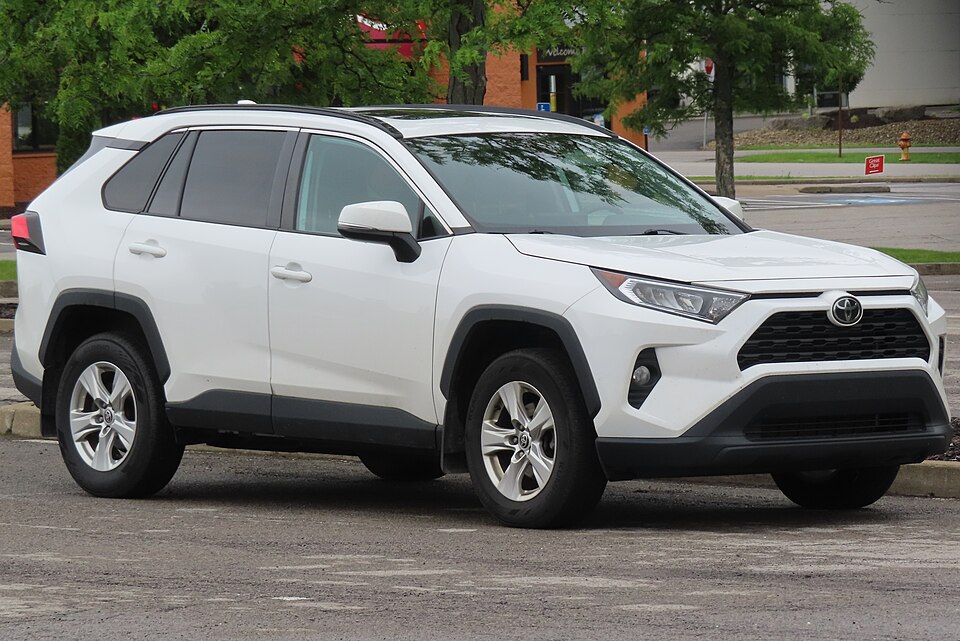
2019 Toyota RAV4

Complaints by component
A complaint can name multiple components.
Complaints by vehicle age
Years between the model year and the reported incident.
View as table
| 0 | 248 |
| 1 | 126 |
| 2 | 59 |
| 3 | 76 |
| 4 | 117 |
| 5 | 131 |
| 6 | 87 |
| 7 | 31 |
Complaints by odometer reading
Mileage at failure, where the complainant reported it. When this curve rises early, problems show up while the vehicle is still young.
View as table
| 0k | 221 |
| 10k | 31 |
| 20k | 12 |
| 30k | 12 |
| 40k | 6 |
| 50k | 4 |
| 60k | 8 |
| 70k | 2 |
| 80k | 4 |
| 90k | 1 |
| 100k | 0 |
| 110k | 3 |
| 120k | 2 |
| 130k | 1 |
Recalls (7)
steering · 2020-06-24 · 20V373000
Toyota Motor Engineering & Manufacturing (Toyota) is recalling certain 2019-2020 RAV4 and 2020 RAV4 Hybrid vehicles equipped with electric power steering (EPS). Water may enter through the steering gear box cover and cause a loss of electric power steering assist.
Risk: A loss of power steering assist could increase steering effort at low vehicle speeds, increasing the risk of a crash.
Remedy: Toyota will notify owners, and dealers will replace the power steering gear box, free of charge. The recall began August 17, 2020. Owners may contact Toyota customer service at 1-888-270-9371. Toyota's number for this recall is 20TB11 / 20TA11.
engine and engine cooling · 2020-06-02 · 20V064000
Toyota Motor Engineering & Manufacturing (Toyota) is recalling certain 2020 Toyota Avalon Hybrid, Camry, Camry Hybrid and Lexus ES300h and 2019-2020 RAV4 and RAV4 Hybrid vehicles equipped with 2.5L 4-Cylinder engines. Porosity in the engine castings may result in cracks than can allow coolant to leak internally and/or externally.
Risk: A coolant leak can cause the engine to overheat and cause a vehicle stall in conventional gasoline vehicles, increasing the risk of a crash. Additionally, for all involved vehicles, the engine may get damaged mechanically, possibly resulting in an engine oil leak, increasing the risk of a fire.
Remedy: Toyota will notify owners, and dealers will inspect and replace the engine including the engine block, as necessary, free of charge. The recall began April 3, 2020. Owners may contact Toyota customer service at 1-888-270-9371 or Lexus at 1-800-255-3987. Toyota's number for this recall is 20TA04. Lexus' number for this recall is 20LA02.
suspension · 2020-05-20 · 20V286000
Toyota Motor Engineering & Manufacturing (Toyota) is recalling certain 2019-2020 RAV4 and RAV4 Hybrid vehicles. The front lower suspension arms may have cracks, which may result in the suspension arm separating from the front wheel assembly.
Risk: If a suspension control arm breaks, it can result in a loss of vehicle control, increasing the risk of a crash.
Remedy: Toyota will notify owners, and dealers will replace both front lower suspension arms, free of charge. This recall began August 10, 2020. Owners may contact Toyota customer service at 1-888-270-9371. Toyota's interim numbers for this recall are 20TB08 / 20TA08.
fuel system, gasoline · 2020-04-11 · 20V682000
Toyota Motor Engineering & Manufacturing (Toyota) is recalling certain 2018-2019 4Runner, 2019-2020 Avalon, 2019 Corolla Hatchback, 2017-2019 Highlander, 2018-2020 Camry, 2020 Corolla, 2018-2019 Land Cruiser, 2017-2020 Tacoma, 2019-2020 RAV4, 2019-2020 Sequoia, 2017-2020 Sienna, 2019-2020 Tundra, 2018-2020 Lexus ES350, 2017 Lexus GS200t, 2017-2019 Lexus GS350, 2019 Lexus GS300, 2018-2020 Lexus LC500h, 2019-2020 Lexus LS500, 2018-2019 Lexus GX460, 2017 Lexus IS200t, 2019 Lexus IS300, 2019 Lexus IS350, 2018-2020 Lexus LC500, 2018 Lexus LS500, 2019 Lexus LS500h, 2018-2019 Lexus LX570, 2017 Lexus RC200t, 2019 Lexus RC300, RC350, 2017 and 2019-2020 Lexus RX350, 2018-2020 RX350L, 2019 Lexus UX200, 2018-2019 Lexus NX300 vehicles. The low-pressure fuel pump inside the fuel tank may fail.
Risk: If the fuel pump fails, the engine can stall while driving, increasing the risk of a crash.
Remedy: Toyota will notify owners, and dealers will replace the fuel pump assembly with an improved one, free of charge. Owners of specific models were notified that remedy parts were available starting January 21, 2021. Owners of other models will be notified as remedy parts become available. Remedy parts should be available for all affected vehicles by late March 2021. Owners may contact Toyota customer service at 1-888-270-9371 or Lexus customer service at 1-800-255-3987. Note: This recall is an expansion of recall 20V-012. Toyota's number for this recall is 20TA02. Lexus' number for this recall is 20LA01.
equipment · 2019-06-28 · 19V503000
Southeast Toyota Distributors, LLC (SET) is recalling certain 2017-2019 Toyota Camry, Corolla, Rav4, Sienna, and Yaris iA vehicles equipped with factory-installed floor mats. The load carrying capacity modification label may be incorrect. As such, these vehicles fail to comply with the requirements of Federal Motor Vehicle Safety Standard (FMVSS) number 110, "Tire Selection and Rims."
Risk: An incorrect label may lead to unintentionally overloading the vehicle, increasing the risk of a crash.
Remedy: SET will notify owners and provide a corrected label for placement over the inaccurate label, free of charge. The recall began August 23, 2019. Owners may contact Toyota customer service at 1-888-270-9371. SET's number for this recall is SET19A.
back over prevention · 2019-06-08 · 19V576000
Toyota Motor Engineering & Manufacturing (Toyota) is recalling certain 2019 RAV4 and RAV4 Hybrid vehicles. Due to a damaged electrical connector, the back-up camera may not activate when the vehicle is in reverse. As such, these vehicles fail to comply to Federal Motor Safety Standard (FMVSS) number 111, "Rearview Mirrors."
Risk: If the backup camera system does not activate and the driver does not check his/her surroundings while reversing, there is an increased risk of a crash.
Remedy: Toyota will notify owners, and dealers will inspect the back-up camera system and replace the audio display unit, if necessary, free of charge. The recall began September 27, 2019. Owners may contact Toyota customer service at 1-888-270-9371. Toyota's number for this recall is K0N.
equipment · 2019-03-27 · 19V244000
Gulf States Toyota (GST) is recalling certain 2019 C-HR, 4Runner, Avalon, Avalon Hybrid, Camry, Camry Hybrid, Highlander, Land Cruiser, Prius, RAV4, Sequoia, Tacoma, Sienna, Tundra and Yaris vehicles. The text on the load capacity label may become illegible. As such, these vehicles fail to comply with the requirements of Federal Motor Vehicle Safety Standard (FMVSS) number 110, "Tire Selection and Rims."
Risk: If the driver cannot read the label, they may unknowingly overload the vehicle, increasing the risk of a crash.
Remedy: GST will notify owners, and dealers will provide corrected load carrying capacity modification labels, free of charge. The recall began May 24, 2019. Owners may contact GST customer service at 1-800-444-1074. GST's number for this recall is 19R1.
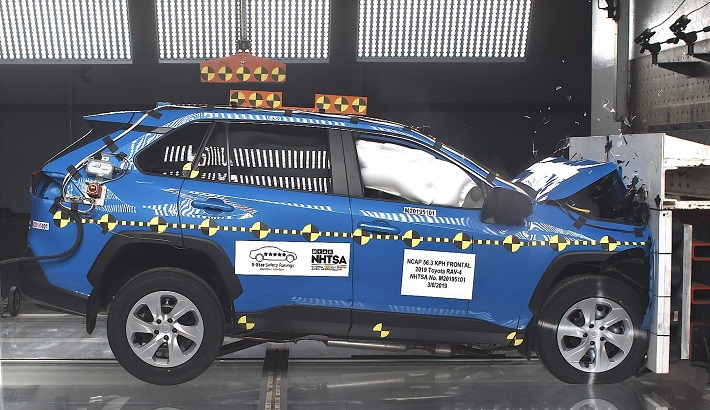
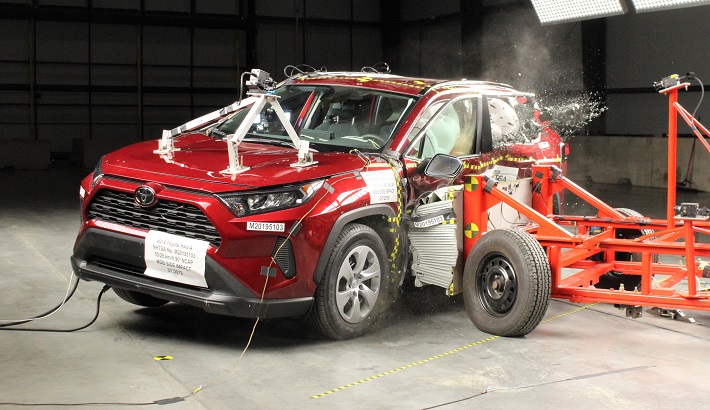
Crash-test ratings (NHTSA NCAP)
Recent complaints
While driving in the mountains on a hot day, the car suddenly reported numerous faults, including check engine, parking brake malfunction, pre-collision system malfunction, AWD system malfunction, and secondary collision brake system malfunction. The car lost power and forced us to pull over on the side of a dangerous mountain highway. We powered-off the car for a few minutes and started it again and were able to proceed to our nearby remote mountain destination without another loss of power, but the faults remained. The next day we were able to get the car to a nearby NAPA store to read the check engine codes, which there were only 2 of the "P0087" code. I had them clear the fault codes in order to be able to safely drive the car (~120 miles) back home. Some quick research shows a known issue and TSB for that in our exact high-altitude and high-temperature situation - Toyota T-SB-0058-22, related to a known design flaw with the ECM and fuel suction tube. Luckily, it did not throw the errors again during our drive home. I made an appointment at our local AutoNation Toyota Arapahoe for the following week. I detailed the issue and provided pictures of the errors - including the code reader display. The dealer claimed to not find any issues and refused to address/execute the TSB, stating that the code must be active and present in order for them to fix it and that my pictures were not sufficient proof. I explained that it was an unacceptable safety risk to have left the car in that state and that the issue is known to only occur in certain conditions (e.g. high-altitude, high-temperature mountain driving). Issue remains un-addressed, which is highly unacceptable and poses a serious on-going safety risk.
We were driving down the highway passing another vehicle when we lost steering and the dash said "Steering Power Loss". We pulled to the side of the road where the vehicle stalled and would not restart. Probably 10-15 minutes later the vehicle started and we eventually made it to our destination. It was quite scary trying to get to the side of the road, in heavy traffic, and pulling over where there really was no shoulder, and not knowing whether the car would eventually restart or what. Although 2019 Toyota Rav4's have been recalled for this very issue, for some reason our VIN is not listed.
The contact owns a 2019 Toyota Rav4. The contact stated that while accelerating, the vehicle started shaking, jerking, and vibrating abnormally before stopping. Additionally, the exterior door handles on the front passenger’s side door, rear passenger’s side door, and rear driver’s side door had detached from the vehicle. There were no warning lights illuminated. The local dealer was not contacted. The vehicle was not diagnosed or repaired. The manufacturer was not notified of the failure. The failure mileage was approximately 69,053.
Display of RAV4 Hybrid is malfunctioning as it randomly turns on and off at frequent intervals, the screen turns on an off in a similar manner, the display controls are not operative even if displayed. This occurred right after the Dealer (355 Toyota of Rockville, [XXX] ) conducted a recall procedure on a wire harness. Immediately after these repairs, it was noticed that the display started to malfunction. It has never malfunctioned before. I went back to the Dealership and the manager said that the display problem was unrelated to the recall maintenance. So I am reporting it here. INFORMATION REDACTED PURSUANT TO THE FREEDOM OF INFORMATION ACT (FOIA), 5 U.S.C. 552(B)(6)
While driving down a county road at approx 40mph, the glass of the sunroof of my 2019 RAV4 suddenly cracked, with shards falling down into the vehicle. There was no apparent cause or impact. After moving to a safe location to further inspect, I noticed the following details; - the rectangular glass of the sunroof is cracked through at multiple points along the edges of the pane, and a "web" pattern of partially shattered glass extends across the whole pane. - there is no pattern that I would associate with an impact spot and no evidence of impact from any falling object. At the time, I was driving under open skies in a rural area, not under any trees, overpasses, etc. - the glass appears to be buckled outwards, as though internal cabin pressure was a factor - the car had been parked outside my office all day, the day was overcast with a high in the 80s. There was no rain/hail/etc. Overall, the lack of apparent impact and outward-buckling pattern raise concern for a material or manufacturing defect. While no one was hurt in this incident, a similar failure could have been a significant problem if it occurred on an interstate or other location the operator could not pull over, or during adverse weather. The vehicle is being taken for inspection at Stapp interstate Toyota, Frederick CO on 29 July 2026.