2019 Toyota Camry

Complaints by component
A complaint can name multiple components.
Complaints by vehicle age
Years between the model year and the reported incident.
View as table
| 0 | 71 |
| 1 | 63 |
| 2 | 49 |
| 3 | 37 |
| 4 | 27 |
| 5 | 52 |
| 6 | 53 |
| 7 | 40 |
Complaints by odometer reading
Mileage at failure, where the complainant reported it. When this curve rises early, problems show up while the vehicle is still young.
View as table
| 0k | 68 |
| 10k | 14 |
| 20k | 15 |
| 30k | 12 |
| 40k | 6 |
| 50k | 7 |
| 60k | 2 |
| 70k | 4 |
| 80k | 3 |
| 90k | 3 |
| 100k | 1 |
| 110k | 2 |
| 120k | 0 |
| 130k | 1 |
| 140k | 0 |
| 150k+ | 2 |
Recalls (6)
service brakes, hydraulic · 2021-11-17 · 21V890000
Toyota Motor Engineering & Manufacturing (Toyota) is recalling certain 2018-2019 Camry vehicles. The vane cap inside the vacuum pump may break, causing the pump to fail, which could result in a sudden loss of braking assist.
Risk: A sudden loss of braking assist can increase the risk of a crash.
Remedy: Dealers will repair or replace the vacuum pump, as necessary, free of charge. Owner notification letters were mailed May 16, 2022. Owners may contact Toyota customer service at 1-800-331-4331.
fuel system, gasoline · 2020-04-11 · 20V682000
Toyota Motor Engineering & Manufacturing (Toyota) is recalling certain 2018-2019 4Runner, 2019-2020 Avalon, 2019 Corolla Hatchback, 2017-2019 Highlander, 2018-2020 Camry, 2020 Corolla, 2018-2019 Land Cruiser, 2017-2020 Tacoma, 2019-2020 RAV4, 2019-2020 Sequoia, 2017-2020 Sienna, 2019-2020 Tundra, 2018-2020 Lexus ES350, 2017 Lexus GS200t, 2017-2019 Lexus GS350, 2019 Lexus GS300, 2018-2020 Lexus LC500h, 2019-2020 Lexus LS500, 2018-2019 Lexus GX460, 2017 Lexus IS200t, 2019 Lexus IS300, 2019 Lexus IS350, 2018-2020 Lexus LC500, 2018 Lexus LS500, 2019 Lexus LS500h, 2018-2019 Lexus LX570, 2017 Lexus RC200t, 2019 Lexus RC300, RC350, 2017 and 2019-2020 Lexus RX350, 2018-2020 RX350L, 2019 Lexus UX200, 2018-2019 Lexus NX300 vehicles. The low-pressure fuel pump inside the fuel tank may fail.
Risk: If the fuel pump fails, the engine can stall while driving, increasing the risk of a crash.
Remedy: Toyota will notify owners, and dealers will replace the fuel pump assembly with an improved one, free of charge. Owners of specific models were notified that remedy parts were available starting January 21, 2021. Owners of other models will be notified as remedy parts become available. Remedy parts should be available for all affected vehicles by late March 2021. Owners may contact Toyota customer service at 1-888-270-9371 or Lexus customer service at 1-800-255-3987. Note: This recall is an expansion of recall 20V-012. Toyota's number for this recall is 20TA02. Lexus' number for this recall is 20LA01.
fuel system, gasoline · 2020-01-13 · 20V012000
Toyota Motor Engineering & Manufacturing (Toyota) recalled certain 2018-2019 4Runner, Highlander, Camry, Land Cruiser, Sequoia, Sienna, Tacoma and Tundra, and Lexus RC 300, RC 350, GS 350, GX 460, IS 300, LC 500, LS 500, LX 570, RX 350L, and 2019 Toyota Avalon and Corolla, and certain Lexus NX 300, and ES 350 vehicles on January 13, 2020. On March 4, 2020, Toyota expanded the recall to include certain 2014-2015 Toyota 4Runner and Land Cruiser, 2018 Avalon, Corolla, 2014 FJ Cruiser, 2017 Sienna and Lexus 2018 ES 350, 2018-2019 GS 300, 2013-2014 GS350, 2014-2015 GX 460, IS 350 and LX 570, 2014 IS F, 2018-2019 IS 350, LC 500H and LS 500H, 2013-2015 LS 460, 2015 NX 200T and RC350, 2017 RC 200T and RX 350. Toyota also removed the 2018-2019 Toyota 4Runner and Land Cruiser and 2018-2019 Lexus GX 460 and LX 570 and 2019 NX300 from inclusion in this recall. On March 19, 2020, Toyota expanded the recall to include 2015 Lexus GS350 vehicles. The low-pressure fuel pump inside the fuel tank may fail.
Risk: If the fuel pump fails, the engine can stall while driving, increasing the risk of a crash.
Remedy: Toyota will notify owners, and dealers will replace the fuel pump, free of charge. The recall began May 4, 2020. Owners may contact Toyota customer service at 1-888-270-9371 or Lexus customer service at 1-800-255-3987. Toyota's numbers for this recall are 20TB02 and 20TA02 for Toyota vehicles and 20LB01 and 20LA01 for Lexus vehicles.
equipment · 2019-06-28 · 19V503000
Southeast Toyota Distributors, LLC (SET) is recalling certain 2017-2019 Toyota Camry, Corolla, Rav4, Sienna, and Yaris iA vehicles equipped with factory-installed floor mats. The load carrying capacity modification label may be incorrect. As such, these vehicles fail to comply with the requirements of Federal Motor Vehicle Safety Standard (FMVSS) number 110, "Tire Selection and Rims."
Risk: An incorrect label may lead to unintentionally overloading the vehicle, increasing the risk of a crash.
Remedy: SET will notify owners and provide a corrected label for placement over the inaccurate label, free of charge. The recall began August 23, 2019. Owners may contact Toyota customer service at 1-888-270-9371. SET's number for this recall is SET19A.
equipment · 2019-03-27 · 19V244000
Gulf States Toyota (GST) is recalling certain 2019 C-HR, 4Runner, Avalon, Avalon Hybrid, Camry, Camry Hybrid, Highlander, Land Cruiser, Prius, RAV4, Sequoia, Tacoma, Sienna, Tundra and Yaris vehicles. The text on the load capacity label may become illegible. As such, these vehicles fail to comply with the requirements of Federal Motor Vehicle Safety Standard (FMVSS) number 110, "Tire Selection and Rims."
Risk: If the driver cannot read the label, they may unknowingly overload the vehicle, increasing the risk of a crash.
Remedy: GST will notify owners, and dealers will provide corrected load carrying capacity modification labels, free of charge. The recall began May 24, 2019. Owners may contact GST customer service at 1-800-444-1074. GST's number for this recall is 19R1.
air bags · 2019-01-08 · 19V567000
Toyota Motor Engineering & Manufacturing (Toyota) is recalling certain 2019 Camry vehicles. The Occupant Classification System (OCS) may have been improperly calibrated, which may prevent the proper deployment of the front passenger air bag and knee air bag, in the event of a crash. As such, these vehicles fail to comply with the requirements of Federal Motor Vehicle Safety Standard (FMVSS) number 208, "Occupant Crash Protection."
Risk: In the event of a crash, if the air bags do not deploy as designed, the front seat passenger has an increased risk of an injury.
Remedy: Toyota will notify owners, and dealers will recalibrate the OCS, free of charge. The recall began August 27, 2019. Owners may contact Toyota customer service at 1-888-270-9371. Toyota's number for this recall is K0M.
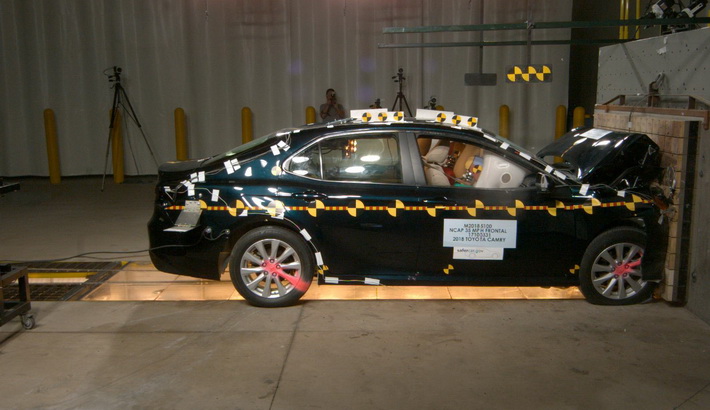
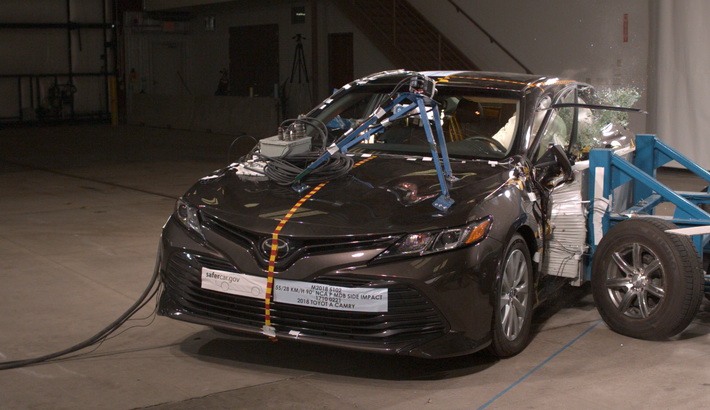
Crash-test ratings (NHTSA NCAP)
Recent complaints
The engine overheated due to a failed coolant pump at approximately 47,000 miles. Following diagnostic testing, the Toyota dealership retrieved diagnostic code P26CB71 and confirmed a cooling system fault. The repair consisted of replacing the coolant pump and thermostat.
The power panoramic sunroof is malfunctioning. The sunroof intermittently fails to open or close properly and may become stuck in the tilted/open position. The motor makes clicking/grinding noises, and the automatic open/close function does not consistently work. Multiple attempts with the switch are sometimes required, and the sunroof has become difficult or impossible to close. This creates a safety concern because the sunroof may remain open and cannot reliably be closed.
The contact owns a 2019 Toyota Camry. The contact stated that while driving 35 MPH, the vehicle suddenly stalled. The contact stated that the pre-collision, secondary brake, lane departure, and engine warning lights were illuminated and flashed on and off. The vehicle was restarted after depressing the accelerator pedal, but the vehicle stalled shortly afterwards. The local dealer was not contacted. The vehicle was not diagnosed or repaired. The manufacturer was not notified of the failure. The approximate failure mileage was 100,000.
I believe the windshield is defective. I have had multiple chips from small debris but it leaves a surprisingly large crack. These were from interstate driving. I had four different glass crack claims in the last two years. These cracks are deep and concerning that they could penetrate through the windshield.
The transmission is failing after about 65,000 miles (7 years from first use). It can be inspected upon request. My safety is at risk in that the transmission is steadily getting worse and could fail at any time or any speed. The transmission failure was diagnosed and confirmed by a local Toyota dealer. There are no warning lights. A high-pitched whine is heard while driving which gets higher with faster vehicle speed.