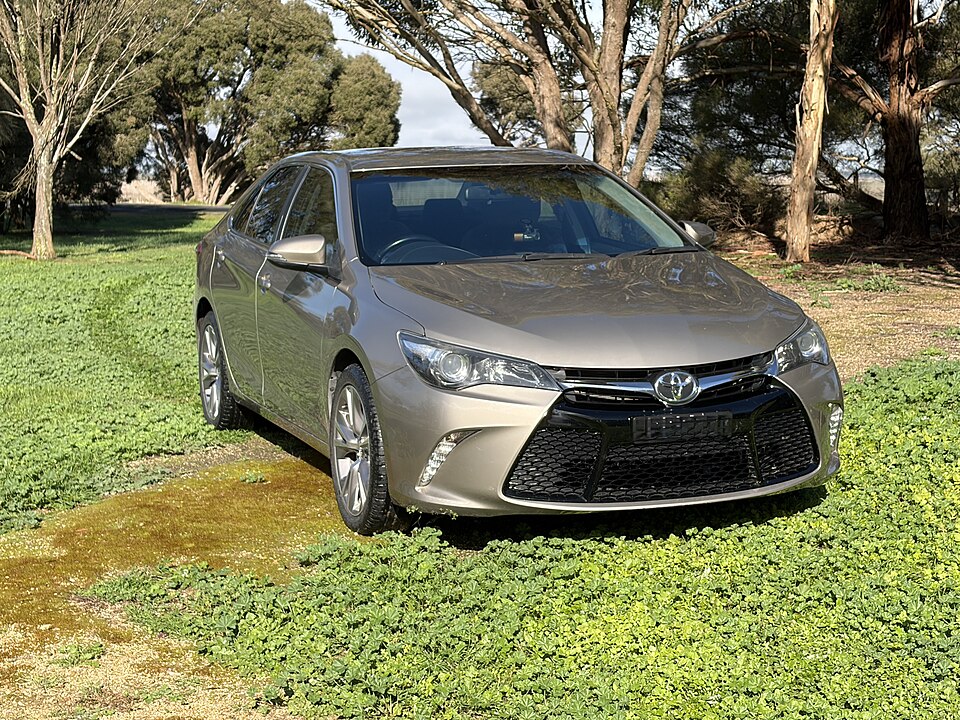
2012 Toyota Camry

Complaints by component
A complaint can name multiple components.
Complaints by vehicle age
Years between the model year and the reported incident.
View as table
| 0 | 80 |
| 1 | 88 |
| 2 | 88 |
| 3 | 63 |
| 4 | 40 |
| 5 | 51 |
| 6 | 47 |
| 7 | 52 |
| 8 | 33 |
| 9 | 36 |
| 10 | 21 |
| 11 | 20 |
| 12 | 7 |
Complaints by odometer reading
Mileage at failure, where the complainant reported it. When this curve rises early, problems show up while the vehicle is still young.
View as table
| 0k | 87 |
| 10k | 46 |
| 20k | 44 |
| 30k | 36 |
| 40k | 30 |
| 50k | 23 |
| 60k | 25 |
| 70k | 25 |
| 80k | 21 |
| 90k | 15 |
| 100k | 12 |
| 110k | 12 |
| 120k | 13 |
| 130k | 14 |
| 140k | 9 |
| 150k+ | 18 |
Recalls (2)
electrical system · 2013-10-17 · 13V442000
Toyota is recalling certain model year 2012-2013 Avalon, Avalon HV, Venza, Camry, and Camry HV vehicles. In the affected vehicles, the drain hose for the air conditioning condenser may become clogged causing water to accumulate at the bottom of the air conditioning condenser unit housing. The accumulated water may then leak through a seam in the housing onto the air bag control module potentially resulting in a short circuit of the module.
Risk: A short circuit may cause the air bags to become disabled or inadvertently deploy. An inadvertent airbag deployment can increase the risk of injury or the possibility of a crash. An inoperative airbag can increase the risk of injury in a severe crash. The power steering assist could also become inoperable resulting in increased steering effort and can increase the risk of a crash at low speeds.
Remedy: Toyota will notify owners, and dealers will seal the air conditioning condenser unit housing and install a protective cover on the airbag control module, free of charge. The recall began on February 5, 2014. Owners may contact Toyota at 1-800-331-4331.
air bags · 2013-01-16 · 13V014000
Southeast Toyota Distributors, LLC (SET) is recalling certain models interspersed through model years 2009 through 2013 as follows: model year 2009-2012 Tacoma, 4Runner, Camry, Camry Hybrid, Prius, and RAV4; model year 2009-2010 Avalon, FJ Cruiser, and Highlander Hybrid; model year 2010-2013 model year Corolla, Sienna and Tundra; model year 2009-2013 Highlander and Venza; model year 2012 Prius V; and model year 2010-2012 Sequoia. During modification by SET to include accessories such as leather seat covers, seat heaters or headrest DVD systems, these vehicles may not have had the passenger seat occupant sensing system calibration tested. Without passing the calibration test, the occupant sensing system may not operate as designed.
Risk: If the front passenger seat occupant sensing system is out of calibration, the front passenger airbags may not deploy or they may deploy inappropriately for the passenger's size and position. This could increase the risk of personal injury during the event of a vehicle crash necessitating airbag deployment.
Remedy: Southeast Toyota will notify owners, and dealers will test the sensitivity of the occupant detection sensors, and recalibrate them as necessary. The recall began on March 21, 2013. Owners may contact Southeast Toyota at 1-800-301-6859.
Crash-test ratings (NHTSA NCAP)
Recent complaints
2012 Toyota Camry LE developed severe transmission shudder/vibration during normal driving, especially around 25–35 mph and 45–60 mph. The vehicle also experienced noticeable vibration when shifting into Reverse and Drive. An OBD scan previously detected diagnostic trouble code P2716 related to transmission pressure control. The transmission fluid was serviced, but the shudder continued. While driving on the highway, the check-engine light came on again. The vehicle was subsequently returned to the seller and a $7,500 settlement was reached. I am reporting this to document the mechanical and powertrain problems experienced with this vehicle.
The contact owned a 2012 Toyota Camry. The contact stated that while driving at an undisclosed speed uphill during flooding conditions, the vehicle slipped and hydroplaned. The contact attempted to correct the steering but lost control of the vehicle, causing the vehicle to drive into a ditch and flip over several times before coming to a complete stop upside down. Upon impact, the air bags failed to deploy. There were no warning lights illuminated nor abnormal sounds coming from the vehicle prior to the crash. The vehicle was towed to a tow yard. A Police report was filed. The vehicle was destroyed. The contact sustained a laceration to the head, scrapes on both legs, an injury to the left arm, and an injury to the right knee. Medical attention was required, including an emergency room visit and doctor visits. The dealer was not notified of the failure. The vehicle was not repaired. The manufacturer was not notified of the failure. The failure mileage was 255,000.
Recall was completed on 11/25/14 for a shudder when hitting 35 to 50. The recall was a software issue and they show that a torque converter may have been needed at a later date to further correct the issue. Looking for Toyota to follow up with a complete recall vs just the software.
I am noticing there is some wiggling and play with the driver’s seat. Every time I hop inside the car, I feel the seat wiggle back a little bit. I notice some movement back and forth when accelerating and braking and it is starting to get very annoying whenever I drive.
The "incident" is not a fault or flaw of my car in any way, but rather is caused by the auto industry's general shift to LED/HID headlights. In my opinion, they make driving unsafe for external observers because they are too bright and create a lot of glare, so that keeping my eyes focused and perceptive of features I need to see in the road directly ahead of me is becoming increasingly difficult, and therefore, by definition, more unsafe. Technology must be improved so that headlights can alter spectral output according to background illumination (dimmer means cooler,) and light output should have finer, adaptive directional control so that more light gets to objects in front that need to be illuminated, and less to oncoming drivers whose visual contrast range may be overwhelmed. I'm [XXX] , and I have the beginnings of cataracts. Older, halogen-based headlights don't interfere much with my vision, but modern headlights do, and quite badly so. This has to improve! INFORMATION REDACTED PURSUANT TO THE FREEDOM OF INFORMATION ACT (FOIA), 5 U.S.C. 552(B)(6)