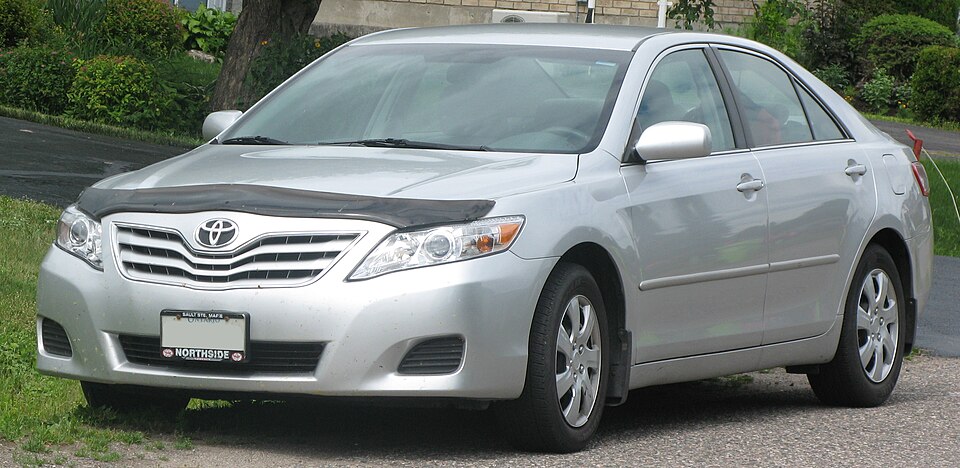
2011 Toyota Camry

Complaints by component
A complaint can name multiple components.
Complaints by vehicle age
Years between the model year and the reported incident.
View as table
| 0 | 96 |
| 1 | 47 |
| 2 | 49 |
| 3 | 62 |
| 4 | 70 |
| 5 | 72 |
| 6 | 56 |
| 7 | 51 |
| 8 | 21 |
| 9 | 25 |
| 10 | 11 |
| 11 | 20 |
| 12 | 15 |
Complaints by odometer reading
Mileage at failure, where the complainant reported it. When this curve rises early, problems show up while the vehicle is still young.
View as table
| 0k | 78 |
| 10k | 33 |
| 20k | 25 |
| 30k | 36 |
| 40k | 40 |
| 50k | 46 |
| 60k | 29 |
| 70k | 33 |
| 80k | 21 |
| 90k | 18 |
| 100k | 13 |
| 110k | 7 |
| 120k | 13 |
| 130k | 5 |
| 140k | 9 |
| 150k+ | 15 |
Recalls (5)
seats · 2014-11-19 · 14V743000
Southeast Toyota Distributors, LLC (SET) is recalling certain model year 2010-2011 Prius and Corolla, 2009-2011 Venza, 2006-2010 Avalon, 2007-2010 FJ Cruiser, 2005-2011 Sienna and Sequoia, 2006-2011 Tacoma 4x2 and 4x4, Camry, Highlander, Tundra 4x2 and 4x4, and 2007-2011 Rav4 and 4Runner. The affected vehicles may experience compression of the seat cushion which may damage the seat heater wiring.
Risk: Damage to the seat heater wiring could cause the wires to short, increasing the risk of the seat burning and causing personal injury to the occupant.
Remedy: SET will notify owners, and dealers will disconnect the heaters with copper strand heating elements and refund the purchase price of the seat heater accessory, free of charge. The recall is expected to began in January 2015. Owners may contact SET customer service at 1-866-405-4226.
suspension · 2014-11-13 · 14V732000
Toyota Motor Engineering & Manufacturing (Toyota) is recalling certain model year 2011 Toyota Camry vehicles manufactured March 8, 2011, to July 20, 2011. In the affected vehicles, the rubber boot on the front suspension lower arm ball joint may have been damaged during manufacturing. The damage could cause the boot to leak lubricant grease which could then cause the ball joint to wear and loosen prematurely.
Risk: A loosened ball joint may separate from the knuckle and could cause a loss of vehicle control, increasing the risk of a crash.
Remedy: Toyota will notify owners, and dealers will inspect and replace the ball joint, free of charge. The recall began on December 16, 2014. Owners may contact Toyota customer service at 1-800-331-4331.
equipment · 2013-09-04 · 13V123000
Southeast Toyota is recalling certain model year 2008 and 2010-2013 Toyota Tundra, 2010-2012 Rav4, 2012 Toyota Sequoia, 2010-2011 Toyota Corolla, 2010-2011 Toyota Camry and Camry Hybrid, 2010-2013 Toyota Highlander and Highlander Hybrid, 2010-2013 Toyota FJ Cruiser, 2011 Toyota Land Cruiser, 2010-2013 Toyota Venza, 2010-2011 Toyota 4Runner, 2010-2013 Toyota Tacoma, 2011-2012 Toyota Sienna, 2012 Toyota Prius, 2013 Scion FR-S, 2011 Scion XD, 2011 Scion XB, and 2012 Scion TC vehicles. These vehicles were sold with labels that were outside the allowable one percent of accuracy of actual weight added. Thus, these vehicles fail to comply with the requirements of Federal Motor Vehicle Safety Standard (FMVSS) Number 110, "Tire Selection and Rims."
Risk: An inaccurate label could lead to owners overloading their vehicles and tires. An overloaded vehicle can result in a tire failure which may result in a vehicle crash, personal injury, or property damage.
Remedy: Southeast Toyota will notify owners and provide a corrected label with instructions concerning its installation. A small group of the affected vehicles will need additonal remedies which are still being developed. The recall began on May 28, 2013. Owners may contact Southeast Toyota at 1-800-301-6859.
air bags · 2013-01-16 · 13V014000
Southeast Toyota Distributors, LLC (SET) is recalling certain models interspersed through model years 2009 through 2013 as follows: model year 2009-2012 Tacoma, 4Runner, Camry, Camry Hybrid, Prius, and RAV4; model year 2009-2010 Avalon, FJ Cruiser, and Highlander Hybrid; model year 2010-2013 model year Corolla, Sienna and Tundra; model year 2009-2013 Highlander and Venza; model year 2012 Prius V; and model year 2010-2012 Sequoia. During modification by SET to include accessories such as leather seat covers, seat heaters or headrest DVD systems, these vehicles may not have had the passenger seat occupant sensing system calibration tested. Without passing the calibration test, the occupant sensing system may not operate as designed.
Risk: If the front passenger seat occupant sensing system is out of calibration, the front passenger airbags may not deploy or they may deploy inappropriately for the passenger's size and position. This could increase the risk of personal injury during the event of a vehicle crash necessitating airbag deployment.
Remedy: Southeast Toyota will notify owners, and dealers will test the sensitivity of the occupant detection sensors, and recalibrate them as necessary. The recall began on March 21, 2013. Owners may contact Southeast Toyota at 1-800-301-6859.
equipment · 2010-03-02 · 10V036000
SOUTHEAST TOYOTA IS RECALLING CERTAIN MODEL YEAR 2005-2011 PASSENGER VEHICLES FOR FAILING TO COMPLY WITH THE REQUIREMENTS OF FEDERAL MOTOR VEHICLE SAFETY STANDARD NO. 110, "TIRE SELECTION AND RIMS." THESE VEHICLES WERE SOLD WITHOUT THE REQUISITE LOAD CARRYING CAPACITY MODIFICATION LABELS.
Risk: A DRIVER MAY OVERLOAD A VEHICLE WHICH MAY INCREASE THE RISK OF A CRASH.
Remedy: DEALERS WILL MAIL TO CONSUMERS THE CORRECTED LABEL OR THE CUSTOMER WILL HAVE THE OPTION FOR DEALERS TO INSTALL THE LABEL FREE OF CHARGE. THE SAFETY RECALL BEGAN ON MAY 27, 2010. OWNERS MAY CONTACT SOUTHEAST TOYOTA AT 1-800-301-6859.
Crash-test ratings (NHTSA NCAP)


Recent complaints
Odometer Fraud. The contact purchased a 2011 Toyota Camry. The contact later obtained a Carfax report which indicated that the odometer was last reported at 192,563. The vehicle was a private sale. At the time of the purchase, the mileage was 105,000.
The contact owned a 2011 Toyota Camry. The contact stated that while driving at 35 MPH, the vehicle hydroplaned and the front driver’s side crashed into the highway median, and the vehicle spun around and the rear passenger’s side crashed into a highway guardrail. The air bags failed to deploy upon impact. Due to the failure, the vehicle was initially towed to an independent tow yard before the insurance company took possession of the vehicle. The vehicle was towed to the insurance company's designated location, where it remained. The contact had a strained neck, a sprained right ankle, and a bruised left knee. A female and a male passenger inside the vehicle sought medical attention for their injuries. The female passenger had whiplash and bruising to the right leg. The male passenger, seated in the rear driver’s side of the vehicle, sustained cuts to the left side of his back after the rear windshield glass shattered upon impact. The Police were called to the scene, and a Police report was filed; however, the contact had not obtained a copy of the report. The vehicle had been deemed a total loss. The failure mileage was approximately 200,000.
1- the stickiness of dashboard 2- the shiny/deflective surface of the dashboard creates as safety hazard.
The contact owns a 2011 Toyota Camry. The contact stated that while driving 35 MPH, the dashboard created a glare on the windshield that reflected into the driver's eyes. Over time, the dashboard became sticky, emitted a slight chemical odor, appeared shiny, and had a clear, porous substance on top. The driver was unable to see while changing lanes or to view oncoming traffic to execute a left turn. The contact called the manufacturer and was informed that there was no coverage program, recall, or warranty for dashboard replacement. The dealer was notified of the failure. The failure mileage was approximately 94,400.
The contact's wife owns a 2011 Toyota Camry. The contact stated that while driving at various speeds, the sun was reflecting off the dashboard, which caused a glare onto the windshield. The glare obstructed the driver's vision and caused a dangerous driving condition. The dashboard became sticky, and there were bubbles on the dashboard from the damage caused by the sun. The manufacturer was notified of the failure and informed the contact that a TSB associated with the failure had expired. The contact was provided a case number. The vehicle was not repaired. The failure mileage was approximately 37,000.