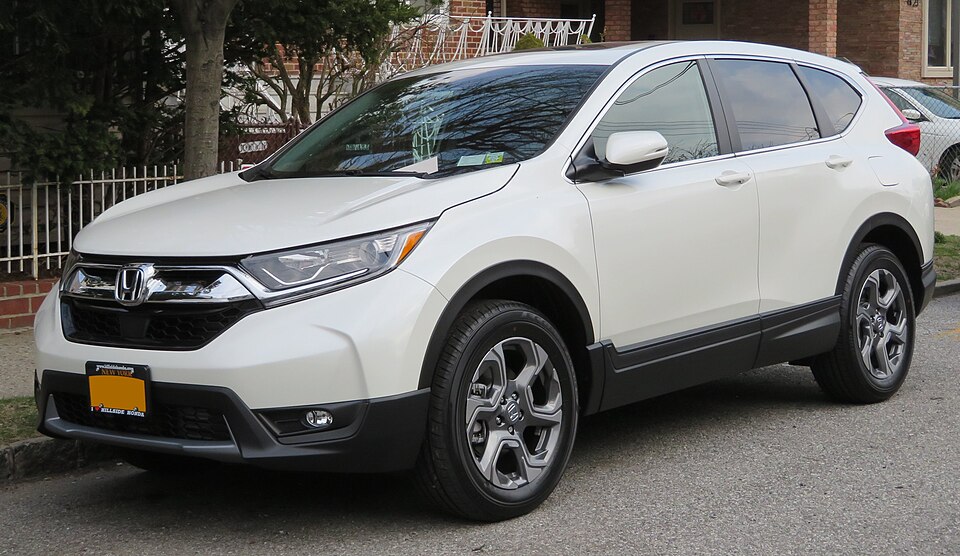
2022 Honda CR-V

Complaints by component
A complaint can name multiple components.
Complaints by vehicle age
Years between the model year and the reported incident.
View as table
| 0 | 27 |
| 1 | 30 |
| 2 | 61 |
| 3 | 59 |
| 4 | 89 |
Complaints by odometer reading
Mileage at failure, where the complainant reported it. When this curve rises early, problems show up while the vehicle is still young.
View as table
| 0k | 5 |
| 10k | 9 |
| 20k | 5 |
| 30k | 1 |
| 40k | 0 |
| 50k | 3 |
| 60k | 1 |
| 70k | 0 |
| 80k | 0 |
| 90k | 2 |
Recalls (3)
air bags · 2026-05-21 · 26V332000
Honda (American Honda Motor Co.) is recalling certain 2018-2021, 2023 Acura TLX, 2019-2024 RDX, 2017-2020, 2022-2026 MDX, 2017-2021, 2023, 2025 Honda Ridgeline, 2017-2022 Pilot, 2019-2021 Passport, 2018-2026 Odyssey, 2019-2022 Insight, 2019-2021 HR-V, 2018-2020 Fit, 2020-2022 CR-V Hybrid, 2017-2022 CR-V, 2017-2018, 2021 Civic Type R, 2017-2021 Civic hatchback, 2016-2020 Civic coupe, 2016-2022 Civic, 2017-2022 Accord Hybrid, and 2016-2022 Accord vehicles. The front passenger seat weight sensor may crack and short circuit, which can cause the air bags to deploy unintentionally during a crash.
Risk: Air bags that deploy unintentionally during a crash increase the risk of injury.
Remedy: Dealers will replace the seat weight sensors, free of charge. Owner notification letters were mailed July 7, 2026. Owners may contact Honda's customer service at 1-888-234-2138. Honda's numbers for this recall are BOL, WO9, OOA, WOM, XOH, NOC, POD, BOE, UOF, POB, EOG, AOI, QO8, TOJ, DO7, and SOK. This recall expands previous NHTSA recall number 24V064. Vehicle Identification Numbers (VINs) involved in this recall will be searchable on NHTSA.gov beginning May 29, 2026.
fuel system, gasoline · 2023-12-18 · 23V858000
Honda (American Honda Motor Co.) is recalling certain 2013-2023 Honda Accord, Civic Coupe, Civic Sedan, Civic Hatchback, Civic Type R, CR-V, HR-V, Ridgeline, Odyssey, Acura ILX, MDX, MDX Hybrid, RDX, RLX, TLX, 2019-2022 Honda Insight, Passport, 2020 Honda CR-V Hybrid, 2018-2019 Honda Clarity PHEV, Fit, and 2015-2020 Honda Accord Hybrid, Pilot, Acura NSX vehicles. The fuel pump inside the fuel tank may fail.
Risk: Fuel pump failure can cause an engine stall while driving, increasing the risk of a crash.
Remedy: Dealers will replace the fuel pump module, free of charge. Owner letters were mailed September 6, 2024. Owners may contact Honda customer service at 1-888-234-2138. Honda's numbers for this recall are KGC and KGD. This recall is an expansion of NHTSA recall numbers 21V-215 and 20V-314.
equipment · 2023-07-27 · 23V524000
Honda (American Honda Motor Co.) is recalling certain 2017, 2020, and 2022 CR-V vehicles. The certification label on the driver's side door states incorrect Gross Vehicle Weight Rating (GVWR), Gross Axle Weight Rating (GAWR), and tire size information. As such, these vehicles fail to comply with the requirements of Federal Motor Vehicle Safety Standard number 110, "Tire Selection and Rims."
Risk: An incorrectly sized tire may cause premature tread wear, or a tire blow out, increasing the risk of a crash.
Remedy: Dealers will install a new corrected label, free of charge. Owner notification letters were mailed September 18, 2023. Owners may contact Honda customer service at 1-888-234-2138. Honda's number for this recall is CF7.
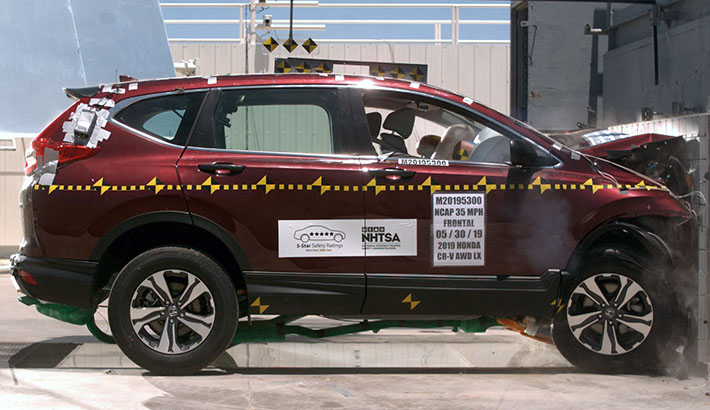
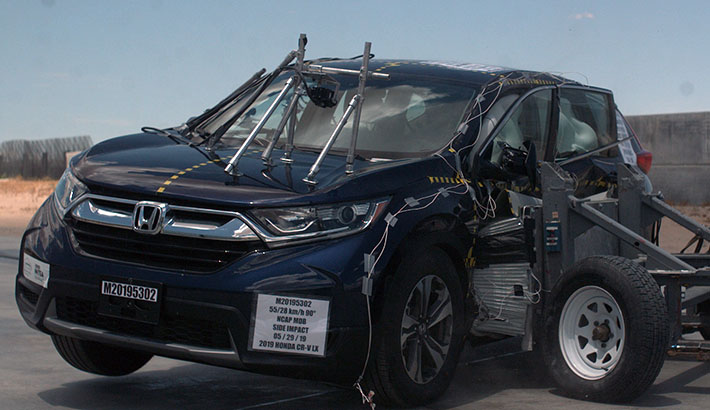
Crash-test ratings (NHTSA NCAP)
Recent complaints
Front passenger seatbelt will sometimes not unlock, requiring passenger to maneuver out of the seatbelt and then not use it.
Sticky steering wheel gears and creaky sounds when turning. Confirmed at dealership during inspection. Current recalls for this part include the 2023-2025 crv so they will not fix it for me even though they confirmed it’s the same problem the recalled cars have
When I am driving on the highway my steering wheel sticks and its difficult to slow down and make either a right or left turn.
I am reporting a potentially serious safety concern involving the front driver's-side window of my 2022 Honda CR-V Hybrid. While I was driving on a highway, shortly after leaving a stoplight, the front driver's-side window suddenly shattered. I had just come from a stoplight and was not traveling at high speed. There was no known collision or apparent object striking the window that caused it to break. Honda has already refused to assist me with the repair. I have found several NHTSA owner complaints involving spontaneous shattering or exploding of side/rear window glass on this generation of Honda CR-V, including: • NHTSA complaint 11493390 — 2022 Honda CR-V: the passenger window reportedly suddenly imploded while the vehicle was being driven, with no apparent object striking it. • NHTSA complaint 11581530 — 2020 Honda CR-V Hybrid: the passenger rear window reportedly exploded while the vehicle was being driven on a highway, with no apparent impact reported. • NHTSA complaint 11571038 — 2021 Honda CR-V: the driver's-side rear window reportedly spontaneously shattered while the vehicle was parked, with no apparent impact or visible damage explaining the breakage. • NHTSA complaint 11749917 — 2021 Honda CR-V: the rear window reportedly suddenly exploded while the vehicle was being backed out of a driveway, with the owner reporting that nothing struck it. I understand that individual consumer complaints do not by themselves establish a manufacturing defect. However, these reports, together with my own incident involving a 2022 CR-V Hybrid, raise a legitimate safety concern that warrants investigation. I am asking NHTSA to review my complaint together with these existing complaints and determine whether further investigation or action is warranted. I am also asking American Honda to document my incident as a potential safety-related glass failure and reconsider its refusal to assist with the repair. A side window suddenly shattering while a vehicle is being
The contact owns a 2022 Honda CR-V. The contact stated that while driving and steering the vehicle, the steering wheel was sticking. Additionally, the vehicle made an abnormal grinding sound while turning the steering wheel. The contact stated that the failure increased while driving 60-80 MPH on the highway and caused a safety risk. The vehicle was taken to the dealer, where it was diagnosed and determined that the steering rack and pinion had failed and needed to be replaced. The vehicle was repaired, and an alignment was performed. The contact associated the failure with an unknown recall. The failure mileage was approximately 20,000.