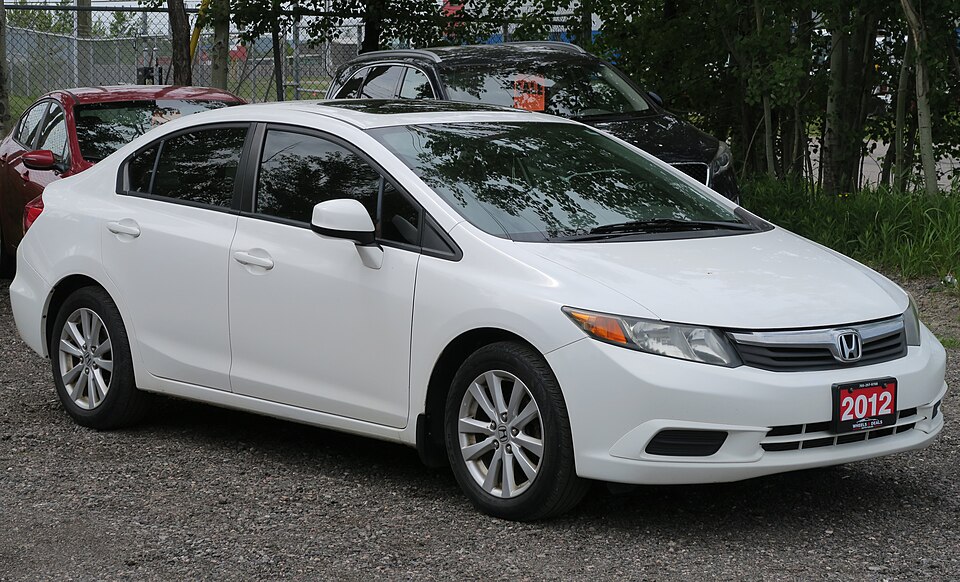
2014 Honda Civic

Complaints by component
A complaint can name multiple components.
Complaints by vehicle age
Years between the model year and the reported incident.
View as table
| 0 | 52 |
| 1 | 34 |
| 2 | 17 |
| 3 | 20 |
| 4 | 24 |
| 5 | 19 |
| 6 | 20 |
| 7 | 24 |
| 8 | 16 |
| 9 | 29 |
| 10 | 16 |
| 11 | 15 |
| 12 | 7 |
Complaints by odometer reading
Mileage at failure, where the complainant reported it. When this curve rises early, problems show up while the vehicle is still young.
View as table
| 0k | 53 |
| 10k | 19 |
| 20k | 13 |
| 30k | 10 |
| 40k | 17 |
| 50k | 6 |
| 60k | 5 |
| 70k | 11 |
| 80k | 12 |
| 90k | 6 |
| 100k | 5 |
| 110k | 1 |
| 120k | 5 |
| 130k | 4 |
| 140k | 0 |
| 150k+ | 8 |
Recalls (2)
power train · 2015-09-15 · 15V574000
Honda (American Honda Motor Co.) is recalling certain model year 2014-2015 Civic vehicles manufactured January 16, 2014, to November 6, 2014 and 2015 Fit vehicles manufactured March 12, 2014, to May 12, 2015. The software settings that control the transmission operation may result in damage to the transmission drive pulley shaft.
Risk: If the transmission drive pulley shaft is damaged, it may break, and the vehicle may lose acceleration or the front wheels may lock up while driving, increasing the risk of a crash.
Remedy: Honda will notify owners, and dealers will update the software for the transmission, free of charge. The recall is expected to begin October 30, 2015. Owners may contact Honda customer service at 1-888-234-2138. Honda's numbers for this recall are JU2 (Civic) and JU3(Fit).
tires · 2014-10-03 · 14V109000
American Honda Motor Co., Inc. (Honda) is recalling certain model year 2014 Honda Civic LX vehicles manufactured November 26, 2013, through January 21, 2014. In the affected vehicles, during mounting of the tires, the tire bead may have gotten pinched between the assembly equipment and the steel wheel rims, resulting in damage to the tire.
Risk: The tire damage could cause the tire to lose air, increasing the risk of a crash.
Remedy: Honda will notify owners, and dealers will inspect and replace any damaged tire, free of charge. The recall began on April 15, 2014. Owners may contact Honda at 1-800-999-1009. Honda's number for this recall is JD8.
Crash-test ratings (NHTSA NCAP)


Recent complaints
Upon starting the car, all of a sudden, the IMID display area screen went white. I turned off the car and I restarted it, and it turned white and then immediately went black. There were no warning lamps or messages prior to the incident. So now I do not get alerts for an open door or tire pressure or maintenance and other notifications. This is a concern, especially when have young children in the vehicle.
Dear Secretary Duffy and NHTSA Leadership, I am writing to ask the Department of Transportation and the National Highway Traffic Safety Administration to take a closer look at the increasing problem of excessive headlight glare on American roads and to consider updating federal headlight standards to better reflect modern lighting technology. I recently watched a video by Car Coach Reports highlighting this issue, and it immediately resonated with me because excessive headlight glare has become a serious problem in my own life since moving to [XXX]. Many people here drive newer vehicles equipped with extremely bright headlights, and the difference is especially noticeable when I am driving my 2014 Honda Civic. I am only [XXX] old, yet I have reached the point where I am genuinely apprehensive about driving after dark. If even one vehicle with these extremely bright headlights is approaching me—or driving behind me—the glare can make it very difficult for me to clearly see the road, surrounding traffic, pedestrians, or lane markings. When the light is coming from behind me, it can also reflect through my mirrors and interfere with my vision. A driver should not have to choose between looking directly at painful glare or temporarily losing the ability to clearly see what is happening around them. I worry about what this means not only for people like me, but especially for older drivers and others whose vision may be more sensitive to glare. I respectfully urge DOT and NHTSA to review whether current standards sufficiently protect drivers from excessive glare and, where appropriate, reduce allowable light levels or adopt other requirements that make nighttime driving safer for everyone. A test on the public in places like [XXX] (with early adopters of technology) may be a good next step. A survey of people in lower-riding cars (and cars in general) who fear driving at night due to excessive glare by default from newer model cars. INFORMATION REDACTED PURSUANT TO THE FREEDOM OF INFORMATION ACT (FOIA), 5 U.S.C. 552(B)(6)
Inspecti9n won't pass due to evap and catalyst but the vehicle shows no codes
I bought a 2014 Honda Civic LX at a used car dealership. The day after I bought it, the passenger-side occupant position sensor came on. I returned the car, and they reset it. It came on again, was reset, and when it came on again, it was replaced. The new one came on again. This time I took it to my Honda dealer, and they reset it. It came on again, and I've been living with it since.I am concerned it might go off unexpectedly or worse, not go off in a crash. I see other years have this as a recall, but my car doesn't come up with a recall.
UNKNOWN component/system issue; entirety of vehicle is available for inspection. Problem has been reproduced by independent service center. Vehicle has been inspected by independent service center and local Honda dealership. No warning lamps/messages or stores codes. 1. Vehicle shakes at idle; periodically jerks and lurches when driving (RPMs, current gear are not relevant, no correlation). 2. When letting off the gas to “coast,” vehicle drops in speed abruptly as if the brakes are being applied which results in a “jolt.” The consequence is the vehicle essentially braking without signal; gas pedal must be engaged at all times unless intending to brake. 3. Vehicle hesitates significantly when accelerating. Even at >80% compression of the gas pedal, the speed of the vehicle will not increase. Only at full compression will the vehicle shift gears and begin to gain in speed yet accompanied by rough shuttering and loud, “airy” sounding rev. This is outside of the operational characteristics expected with the CVT transmission. Moderate to severe safety concern. Notes: Oil and transmission fluid have been drained and replaced at the dealership both less than 3k miles ago. Spark plugs and ignition coils have all been replaced with Honda parts less than 1k miles ago.