2018 Honda Accord

Complaints by component
A complaint can name multiple components.
Complaints by vehicle age
Years between the model year and the reported incident.
View as table
| 0 | 165 |
| 1 | 171 |
| 2 | 149 |
| 3 | 147 |
| 4 | 172 |
| 5 | 223 |
| 6 | 318 |
| 7 | 318 |
| 8 | 229 |
Complaints by odometer reading
Mileage at failure, where the complainant reported it. When this curve rises early, problems show up while the vehicle is still young.
View as table
| 0k | 205 |
| 10k | 73 |
| 20k | 79 |
| 30k | 34 |
| 40k | 24 |
| 50k | 22 |
| 60k | 22 |
| 70k | 20 |
| 80k | 16 |
| 90k | 23 |
| 100k | 18 |
| 110k | 15 |
| 120k | 10 |
| 130k | 10 |
| 140k | 7 |
| 150k+ | 16 |
Recalls (6)
air bags · 2026-05-21 · 26V332000
Honda (American Honda Motor Co.) is recalling certain 2018-2021, 2023 Acura TLX, 2019-2024 RDX, 2017-2020, 2022-2026 MDX, 2017-2021, 2023, 2025 Honda Ridgeline, 2017-2022 Pilot, 2019-2021 Passport, 2018-2026 Odyssey, 2019-2022 Insight, 2019-2021 HR-V, 2018-2020 Fit, 2020-2022 CR-V Hybrid, 2017-2022 CR-V, 2017-2018, 2021 Civic Type R, 2017-2021 Civic hatchback, 2016-2020 Civic coupe, 2016-2022 Civic, 2017-2022 Accord Hybrid, and 2016-2022 Accord vehicles. The front passenger seat weight sensor may crack and short circuit, which can cause the air bags to deploy unintentionally during a crash.
Risk: Air bags that deploy unintentionally during a crash increase the risk of injury.
Remedy: Dealers will replace the seat weight sensors, free of charge. Owner notification letters were mailed July 7, 2026. Owners may contact Honda's customer service at 1-888-234-2138. Honda's numbers for this recall are BOL, WO9, OOA, WOM, XOH, NOC, POD, BOE, UOF, POB, EOG, AOI, QO8, TOJ, DO7, and SOK. This recall expands previous NHTSA recall number 24V064. Vehicle Identification Numbers (VINs) involved in this recall will be searchable on NHTSA.gov beginning May 29, 2026.
fuel system, gasoline · 2023-12-18 · 23V858000
Honda (American Honda Motor Co.) is recalling certain 2013-2023 Honda Accord, Civic Coupe, Civic Sedan, Civic Hatchback, Civic Type R, CR-V, HR-V, Ridgeline, Odyssey, Acura ILX, MDX, MDX Hybrid, RDX, RLX, TLX, 2019-2022 Honda Insight, Passport, 2020 Honda CR-V Hybrid, 2018-2019 Honda Clarity PHEV, Fit, and 2015-2020 Honda Accord Hybrid, Pilot, Acura NSX vehicles. The fuel pump inside the fuel tank may fail.
Risk: Fuel pump failure can cause an engine stall while driving, increasing the risk of a crash.
Remedy: Dealers will replace the fuel pump module, free of charge. Owner letters were mailed September 6, 2024. Owners may contact Honda customer service at 1-888-234-2138. Honda's numbers for this recall are KGC and KGD. This recall is an expansion of NHTSA recall numbers 21V-215 and 20V-314.
seat belts · 2023-09-03 · 23V158000
Honda (American Honda Motor Co.) is recalling certain 2017-2020 CR-V, 2018-2019 Accord and Accord Hybrid, 2018-2020 Odyssey, 2019 Insight, and 2019-2020 Acura RDX vehicles. A manufacturing issue with the front seat belts may cause the seat belt buckle channel to interfere with the release button, preventing the seat belt buckle from latching.
Risk: An unlatched seat belt cannot properly restrain the seat occupant during a crash, increasing their risk of injury.
Remedy: Dealers will replace the driver and front passenger seat belt buckle release buttons or the buckle assemblies as necessary, free of charge. Owner notification letters were mailed April 18, 2023. Owners may contact Honda customer service at 1-888-234-2138. Honda's numbers for this recall are NDA, QDB, BDC, MDD, LD9. TDF, FDG, ODH, YDI, ZDE.
electrical system · 2020-10-12 · 20V771000
Honda (American Honda Motor Co.) is recalling certain 2018-2020 Accord Sedan, Accord Hybrid, and 2019-2020 Insight vehicles. A software error may cause intermittent or continuous disruptions in communication between the Body Control Module (BCM) and other components. This may result in malfunctions of various systems such as the windshield wipers and defroster, rearview camera, exterior lights, audible warning of a stopped vehicle, and power window operation. As such, these vehicles fail to comply with the requirements of Federal Motor Vehicle Safety Standard (FMVSS) number 103, "Windshield Defrosting and Defogging Systems" and number 111, "Rear Visibility" as well as FMVSS numbers 104, 108, 114, 118, and 305.
Risk: Various system malfunctions such as inoperative windshield wipers, defroster, rearview camera, or exterior lighting can increase the risk of a crash.
Remedy: Honda will notify owners, and dealers will update the BCM software, free of charge. The recall is expected to begin February 22, 2021. Owners may contact Honda customer service at 1-888-234-2138. Honda's number for this recall is X95.
fuel system, gasoline · 2020-05-28 · 20V314000
Honda (American Honda Motor Co.) is recalling certain 2018-2019 Acura NSX, 2019 Acura RDX, RLX and RLX Sport Hybrid, 2018-2019 Honda Accord, Civic Hatchback, Civic Type R and HR-V, 2019-2020 Insight and 2019 Fit vehicles. The low-pressure fuel pump inside the fuel tank may fail.
Risk: If the fuel pump fails, the engine can stall while driving, increasing the risk of a crash.
Remedy: Honda will notify owners and dealers will replace the fuel pump assembly, free of charge. The recall began July 22, 2020. Owners may contact Honda customer service at 1-888-234-2138.
back over prevention · 2018-09-13 · 18V629000
Honda (American Honda Motor Co.) is recalling certain 2018 Honda Accord and 2019 Honda Insight vehicles. In certain scenarios, the back-up camera center display may not function properly. As such, these vehicles fail to comply with the requirements of Federal Motor Vehicle Safety Standard (FMVSS) number 111, "Rearview Mirrors."
Risk: If the rearview camera display does not show what is behind the vehicle, it can increase the risk of a crash.
Remedy: Honda will notify owners, and dealers will reprogram the display audio unit software, free of charge. The recall began October 30, 2018. Owners may contact Honda customer service at 1-888-234-2138. Honda's numbers for this recall are K2G and V2F.
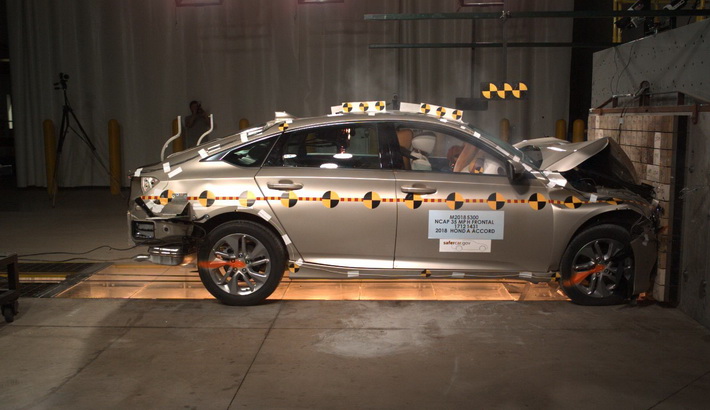
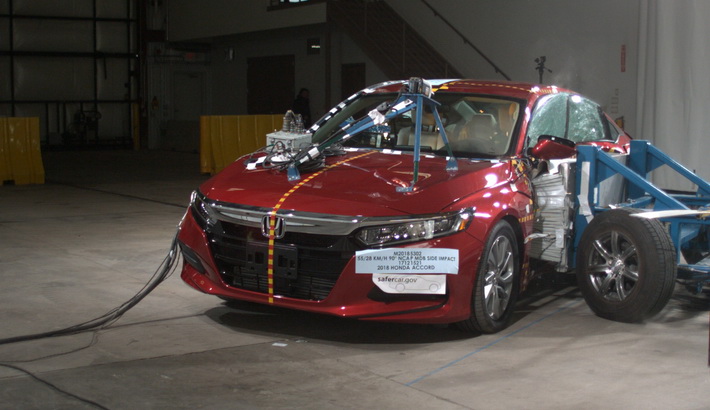
Crash-test ratings (NHTSA NCAP)
Recent complaints
This has happened several times, usually on interstates, about once every few months. It usually takes place where there is a transition in the road, especially if there is a large shadow combined with a car in front of me. The two places that come to mind include merging on, especially during sunrise or sunset (if the highway is set into the ground like in [XXX]), or when passing under a bridge on the highway, esp with a car in front of me that is slowing down. The latter happened earlier this week, I believe on XXX eastbound in [XXX], passing under the XXX or one of the other streets similar to it. INFORMATION REDACTED PURSUANT TO THE FREEDOM OF INFORMATION ACT (FOIA), 5 U.S.C. 552(B)(6)
I contacted Community Honda in Lafayette, La regarding this recall and repair over 2 years ago and it has not been repaired. I was told the part was on back order and have received no communication since
The car hesitates upon acceleration and when it “misses” enough it will flash the engine on the dashboard, and not allow any further acceleration, going into “limp mode”. All the safety controls error on the message center and dashboard warnings all come on, even though it’s only the acceleration/transmission that’s affected. Not sure if it’s fuel injectors or a computer issue, but it’s absolutely dangerous upon entering a highway and hoping to not have system failures, that result in limp mode. I’ve been carrying a 10 mm socket for disconnecting the battery and rebooting the system, when needed. It only helps for a short while.
Reporting fraudulent safety recall compliance & hazardous repair by Honda of Manhasset (Invoice #317524). 1. Recall 23V-858 (Fuel Pump): Dealership registered recall as completed & Service Manager verbally insisted it was done. However, my vehicle's continuous dashcam footage proves fuel pump replacement was NEVER performed. Faced with video evidence, the advisor admitted work wasn't done because the part was out of stock, claiming a "billing error." Invoice reprint says "RECALL NOT PERFORMED, PART NOT IN STOCK" yet they initially processed it, leaving an immediate engine stall risk. 2. Software Campaign & Radar Failure (Service Bulletin 21-068): Dealership performed mandatory Honda Sensing update for Millimeter Wave Radar, wiping old calibration parameters. Per Bulletin 21-068 (Pg 3), the repair is NOT complete until the radar is re-calibrated & the warning light disappears. Instead of performing the radar aiming, the technician left safety systems locked with DTC P2583-76. I authorized a $215 diagnostic fee, but despite having the scanner connected during the update, the technician failed to follow Honda's official troubleshooting protocol to resolve the code and finish the calibration, returning the vehicle with disabled emergency braking features. 3. False Physical Diagnosis: Staff verbally claimed the radar bracket was "bent" to blame a prior impact. Challenged for physical proof, they admitted performing NO physical inspection, stating they "assumed" it was bent solely because the scanner showed P2583-76. This is a blatant lie to cover up their failure to follow factory troubleshooting workflow for this specific DTC, which dictates aiming the radar, not fabricating physical damage to justify leaving the safety repair incomplete.
The car was rough upon idle one day and all the lights came on and systems went down I was bout to drive to a place where the code was read that’s when I first discovered this was a known issue which this model. Head gaket