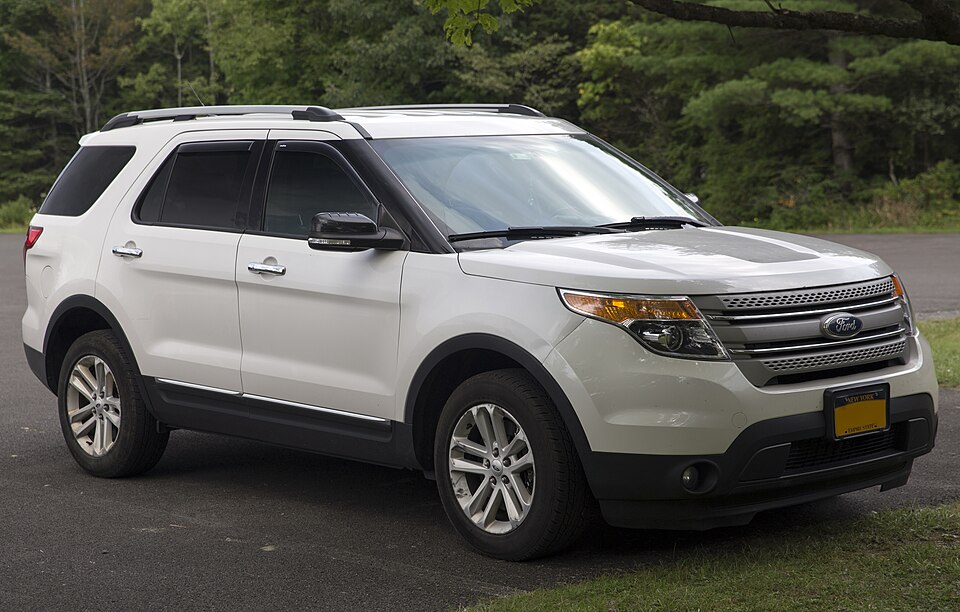
2018 Ford Explorer

Complaints by component
A complaint can name multiple components.
Complaints by vehicle age
Years between the model year and the reported incident.
View as table
| 0 | 48 |
| 1 | 44 |
| 2 | 35 |
| 3 | 48 |
| 4 | 50 |
| 5 | 138 |
| 6 | 175 |
| 7 | 130 |
| 8 | 41 |
Complaints by odometer reading
Mileage at failure, where the complainant reported it. When this curve rises early, problems show up while the vehicle is still young.
View as table
| 0k | 55 |
| 10k | 22 |
| 20k | 26 |
| 30k | 18 |
| 40k | 21 |
| 50k | 22 |
| 60k | 20 |
| 70k | 24 |
| 80k | 15 |
| 90k | 17 |
| 100k | 17 |
| 110k | 11 |
| 120k | 3 |
| 130k | 5 |
| 140k | 2 |
| 150k+ | 6 |
Recalls (6)
suspension · 2026-02-20 · 26V101000
Ford Motor Company (Ford) is recalling certain 2017-2019 Explorer vehicles. The rear suspension toe links may fracture.
Risk: A rear toe link fracture can result in a loss of steering control, increasing the risk of a crash.
Remedy: Dealers will replace the toe links, free of charge. Owner notification letters were mailed on March 16, 2026. Owners may contact Ford Customer Service at 1-866-436-7332. Ford's number for this recall is 26S08. This recall is an expansion of previous NHTSA recall number 21V537. Vehicle Identification Numbers (VINs) involved in this recall will be searchable on NHTSA.gov beginning February 25, 2026.
equipment · 2025-10-10 · 25V685000
Ford Motor Company (Ford) is recalling certain 2016-2019 Lincoln MKC, 2016-2023 Explorer, 2019-2020 Fusion, 2019-2024 Ranger, 2020-2022 Lincoln Corsair, Escape, 2021-2024 Bronco, Bronco Sport, and 2022-2024 Maverick vehicles. The engine block heater may crack and develop a coolant leak, causing it to short circuit when the block heater is plugged in.
Risk: An electrical short circuit can increase the risk of a fire.
Remedy: Owners are advised not to plug in their block heater until the vehicle is remedied. Dealers will replace the block heater, free of charge. Owners will also have a alternative option to replace engine block heater element with a threaded blanking plug, and remove the block heater electrical cord. Interim letters, notifying owners of the safety risk, were mailed December 3, 2025. Additional letters will be sent once the final remedy is available, anticipated September 2026. Owners may contact Ford customer service at 1-866-436-7332. Ford's number for this recall is 25SA4. Vehicle Identification Numbers (VINs) involved in this recall became searchable on NHTSA.gov on October 15, 2025.
structure · 2024-01-19 · 24V031000
Ford Motor Company (Ford) is recalling certain 2011-2019 Explorer vehicles. The A-pillar trim retention clips may not be properly engaged, allowing the trim to detach.
Risk: A detached trim piece can fall off the vehicle, becoming a road hazard and increasing the risk of a crash.
Remedy: Dealers will inspect and replace the A-pillar trim as necessary, free of charge. This will be a phased campaign, with the remedy becoming available in different phases based on model years. Interim owner notification letters informing owners of the safety risk were mailed Feburary 16, 2024. Owner notification letters were mailed on July 18, 2024. Owners may contact Ford customer service at 1-866-436-7332. Ford's number for this recall is 24S02.
structure · 2021-05-05 · 21V316000
Ford Motor Company (Ford) is recalling certain 2016-2019 Explorer vehicles. The retention pins could loosen and allow the roof rail covers to detach from the vehicle.
Risk: A detached roof rail cover can create a road hazard, increasing the risk of a crash.
Remedy: Dealers will install push-pins and replace any damaged rail clips and roof rail covers, as necessary, free of charge. The interim owner notification letter was mailed on June 22, 2021. Owner notification letters (remedy available) were mailed on October 1, 2021. Owners may contact Ford customer service at 1-866-436-7332. Ford's number for this recall is 21S22.
seats · 2019-08-28 · 19V633000
Ford Motor Company (Ford) is recalling certain 2018-2020 F-150 and 2019-2020 F-250, F-350, F-450, and F-550 Super Duty pickup trucks, and 2018-2019 Ford Explorer, 2019-2020 Expedition, and 2020 Escape vehicles equipped with driver and/or passenger's manual front seat back recliner mechanisms. Also included are certain 2020 Ford Explorer and Lincoln Aviator vehicles equipped with rear outboard seats and manual seat back recliner mechanisms. The recliner mechanisms may be missing the third pawl required for seat back strength, resulting in a loose seat back. As such, these vehicles fail to comply with the requirements of Federal Motor Vehicle Safety Standard (FMVSS) numbers 202, "Head Restraints" and 207, "Seating Systems."
Risk: A seat back with an improperly assembled recliner mechanism may have reduced strength and may not adequately restrain an occupant in a crash, increasing the risk of injury.
Remedy: Ford will notify owners, and Ford and Lincoln dealers will inspect the seat structure and replace them, as necessary, free of charge. The recall began October 21, 2019. Owners may contact Ford customer service at 1-866-436-7332. Ford's number for this recall is 19C07.
fuel system, gasoline · 2018-11-14 · 18V807000
Ford Motor Company (Ford) is recalling certain 2018 Ford Explorer vehicles equipped with 2.3L or 3.5L GTDI engine. Due to an assembly error, the fuel pressure sensor may leak fuel.
Risk: A fuel leak in the presence of an ignition source can increase the risk of a fire.
Remedy: Ford will notify owners, and dealers will replace the fuel line assembly, free of charge. The recall began December 7, 2018. Owners may contact Ford customer service at 1-866-436-7332. Ford's number for this recall is 18S35.
Crash-test ratings (NHTSA NCAP)
Recent complaints
The windshield wiper motor failed, causing the windshield wipers to stop operating properly. At the same time, the windshield washer system is unable to spray washer fluid onto the windshield. This significantly reduces visibility during rain and when the windshield becomes dirty, creating a safety hazard. No warning lights were displayed
While driving at highway speed on a 2-lane highway with three children under the age of [XXX] in the vehicle, my 2018 Ford Explorer experienced sudden complete engine failure with no prior warning. No warning lights, no temperature gauge change, no unusual sounds. The vehicle went from operating normally to catastrophic failure instantaneously, forcing me to sharply cross active traffic to exit the roadway. The vehicle came to rest near a train track. The root cause was internal water pump failure. Ford's design places the water pump inside the engine, causing coolant to leak internally with no external indicators and no dashboard warning until catastrophic damage has already occurred. Ford did not install a coolant level sensor in the reservoir, and the only coolant warning available is an overheating alert, which never triggered. I had taken every reasonable precaution. Two thousand miles prior, an oil change showed no coolant contamination. One week prior, I physically checked the coolant level and it was within safe range. Ford's design gave me zero opportunity to detect or prevent this failure. This is a known recurring issue. Over 86 engine complaints have been filed with NHTSA for this model year alone and Ford has been aware of this defect since at least 2007. Despite class action litigation in both Canada and the United States, Ford has not issued a U.S. recall. Repair costs exceed $9,000. I am requesting NHTSA open a formal investigation and compel Ford to issue a U.S. recall. INFORMATION REDACTED PURSUANT TO THE FREEDOM OF INFORMATION ACT (FOIA), 5 U.S.C. 552(B)(6)
The contact owns a 2018 Ford Explorer. The contact stated that while driving at approximately 30 MPH, the check engine warning light illuminated. The vehicle was driven to the residence and then to an independent mechanic shop, where a full diagnostic inspection was not performed; however, the mechanic suspected that coolant bubbled internally and the contact was informed that the head gasket might need to be replaced. The mechanic was unable to disassemble the engine for further inspection. The vehicle was then taken to a dealer, who diagnosed that the water pump needed to be replaced, and the vehicle was repaired. The manufacturer was not notified of the failure. The failure mileage was approximately 112,000.
The contact owns a 2018 Ford Explorer. The contact had received notification of NHTSA Campaign Number: 26V101000 (Suspension), and the recall repair was completed. The contact stated that immediately after the recall repair, while driving on several occasions at various speeds, the rear end of the vehicle fishtailed, and the contact lost control of the vehicle. The vehicle was taken to the same dealer on several occasions; however, the failure could not be duplicated. The contact was advised that the tires needed to be replaced. The contact purchased and replaced the tires and had a four-wheel alignment performed, but the failure persisted, although not as severe. While the vehicle was parked, the contact became aware that the tread on the rear tires was extremely worn. The manufacturer was notified of the failure. The failure mileage was approximately 118,000.
The contact owns a 2018 Ford Explorer. The contact received notification of NTHSA Campaign Number: 24V031000 (Structure); however, the part to do the recall repair was not yet available. The local dealer was contacted. The contact stated that the dealer had exceeded a reasonable amount of time for the recall repair. The manufacturer was not made aware of the issue. The contact had not experienced a failure.